Wednesday, April 7, 2010

Screen shot of Troy pottery on iPad

Quick post...

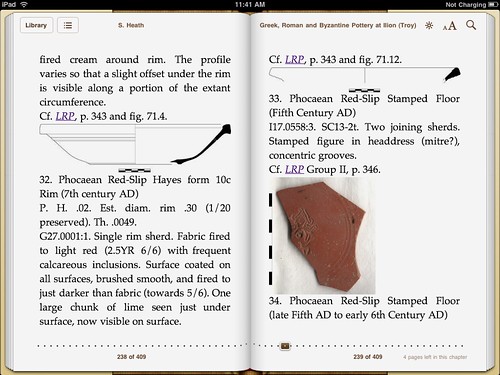
Here's a screen shot of Greek, Roman and Byzantine Pottery at Ilion (Troia) on an iPad. This is in the default reader iBooks.


You can click through to the Flickr page to get the full-size image. This gives a sense of the dimensions of the iPad screen.

OK, lots of work to do to make the page layout better, but I will admit to thinking this is cool.

Some annoyances: This volume is co-edited with Billur Tekkök but only "S. Heath" is showing up at the top. The underlined links don't work. That's also the case in the Stanza ePub reader on my iPhone. Desktop ePub readers do follow links (or at least some of them do). I think they all should, regardless of device.

There will be more to say so stay tuned. The brief "take away" is that eReaders will be one channel for the distribution of archaeological data. I look forward to RadioSchack and the like selling color devices for somewhere between $79.00 and $179.00

p.s. You can get the file here: bit.ly/troyepub .

Saving Archaeology in Italy

The US State Department's Cultural Heritage Center circulated the following e-mail yesterday. I'll have more to say on this soon, but for those of you already inclined to write a letter in support of extending the MoU with Italy that protects its archaeological resources, the deadline is April 22 and you can send your comments in as an attachment to <culprop@state.gov>.


From: "Cultural Property" <CULPROP@state.gov>
Date: April 6, 2010 11:26:52 AM EDT
To: "Cultural Property" <CULPROP@state.gov>
Subject: Meeting of the Cultural Property Advisory Committee

The Department of State’s Cultural Heritage Center would like to draw
your attention to an announcement that will be published in tomorrow’s
Federal Register
(http://www.federalregister.gov/OFRUpload/OFRData/2010-07898_PI.pdf).

[Billing Code: 4710-05]
DEPARTMENT OF STATE
[Public Notice 6945]

Notice of Meeting of the Cultural Property Advisory Committee
In accordance with the provisions of the Convention on Cultural Property
Implementation Act (19 U.S.C. § 2601 et seq.) (the Act) there will be a meeting of
the Cultural Property Advisory Committee on Thursday, May 6, 2010, from 9:00
a.m. to approximately 5:00 p.m., and on Friday, May 7, 2010, from 9:00 a.m. to
approximately 3:00 p.m., at the Department of State, Annex 5, 2200 C Street, N.W.,
Washington, D.C. During its meeting the Committee will review a proposal to
extend the “Memorandum of Understanding Between the Government of the United
States of America and the Government of the Republic of Italy Concerning the
Imposition of Import Restrictions on Categories of Archaeological Material
Representing the Pre-Classical, Classical and Imperial Roman Periods of Italy”
signed in Washington, D.C. on January 19, 2001 and amended and extended in 2006
through an exchange of diplomatic notes. The purpose of this review is for the
Committee to make findings and a recommendation regarding the proposal to extend
this Memorandum of Understanding.

The Committee’s responsibilities are carried out in accordance with
provisions of the Act. The U.S. – Italy Memorandum of Understanding, as
amended and extended, the Designated List of restricted categories, the text of the
Act and related information may be found at
http://exchanges.state.gov/heritage/culprop.

Exercising delegated authority from the President and the Secretary of State,
I have determined that portions of the meeting on May 6 and 7 will be closed
pursuant to 5 U.S.C. § 552b(c)(9)(B) and 19 U.S.C. § 2605(h), because the
disclosure of matters involved in the Committee’s proceedings would compromise
the Government’s negotiation objectives or bargaining positions on the
negotiations of this Memorandum of Understanding. However, on May 6, the
Committee will hold an open session, 9:30 a.m. to approximately 11:30 a.m., to
receive oral public comment on the proposal to extend the Memorandum of
Understanding. Persons wishing to attend this open session should notify the
Cultural Heritage Center of the Department of State at (202) 632-6301 by
Thursday, April 22, 2010, 5:00 p.m. (EDT) to arrange for admission, as seating is
extremely limited.

Those who wish to make oral presentations should request to be scheduled
and submit a written text of the oral comments by Thursday, April 22, 2010, to
allow time for distribution of these comments to Committee members for their
review prior to the meeting. Oral comments will be limited to five minutes each or
less to allow time for questions from members of the Committee and must
specifically address the determinations under section 303(a)(1) of the Act, 19
U.S.C. § 2602(a)(1), pursuant to which the Committee must make findings. This
citation for the determinations can be found at the web site noted above. The
Committee also invites written comments and asks that they be submitted no later
than April 22, 2010. All written materials, including the written texts of oral
statements, should be faxed to (202) 632-6300, if 5 pages or less. Written
comments greater than five pages in length must be duplicated (20 copies) and
mailed to Cultural Heritage Center, SA-5, Fifth Floor, Department of State,
Washington, D.C. 20522- 0505. Express mail is recommended for timely delivery.

Date: MAR 29 2010 _______________________
Judith A. McHale
Under Secretary
Public Diplomacy and Public Affairs
Department of State
[FR Doc. 2010-7898 Filed 04/06/2010 at 8:45 am; Publication Date: 04/07/2010]

Tuesday, March 30, 2010

Of iPads, ePub and Troy

Apple's iPad will start arriving in customer's hands on April 3rd, and at least some of them will end up in the hands of Mediterranean archaeologists. That sounds like an opportunity so I've spent the last few days playing around with ePub software.

I can quickly say that all the desktop readers that I've seen are terrible. Adobe Digital Editions? Ugly. The Stanza desktop version? Ugly and doesn't show my images. Lovely Reader looks OK but does a bad job of laying out text and image.

The Stanza reader on the iPhone is decent and that's what I've been testing against.

The most useful application is far-and-away Calibre. Once I figured out to install the command-line tools, converting xhtml to epub is a single step. There are lots of options to play with, but the basic idea is simple.

So... I spent a little time simplifying the xslt stylesheets that convert the database for Greek, Roman and Byzantine Pottery at Ilion into xhtml. Then I pointed Calibre at the resulting file. You can download an early version of the results here. Don't expect too much. No TOC, bad spacing so it's hard to distinguish catalog entries, other varied problems. But all will improve over time.

To get this on an iPhone you need to load Stanza on to it. Then "Get Books" -> "Downloads" -> "Edit" -> "Download Book from URL". Typing a long URL is a pain on the iPhone so enter this: http://bit.ly/troyepub.

Again, it's super-preliminary so keep an eye out for improvements. And if anybody gets this onto an iPad, let me know how it looks. I'll try it myself soon enough but not right on April 3rd.

Tuesday, March 23, 2010

SPARQL Based Navigation of RDFa Encoded Named Entities

This is a quick heads up on a new feature at Nomisma.org, the ANS-hosted project assigning stable URIs to numismatic concepts.

At http://nomisma.org/id/lyttus you'll find a very brief representation of the ancient site of Lyttus in Crete. It links to the relevant Wikipedia article and Barrington Atlas ID so it should be unambiguous which site we mean and it should be easy to find out further information. As a convenience, and to make it easy to put a dot on the map, the page also has latlong info.

This post is about the list of URIs prefaced by the text "The following Nomisma IDs refer to this ID:". If you click on http://nomisma.org/id/igch0151, you'll get a description of a hoard of coins as published in Inventory of Greek Coin Hoards.

Nomisma.org uses RDFa so the markup of the hoard includes the snippet: <span rel="nm:mint" resource="lyttus">Lyttus: 1 dr.</span> . You can click on "Show Markup in Page" to see this.

All the descriptions of numismatic concepts are collected in a single RDFa file at http://nomisma.org/nomisma.org.xml and as RDF-XML at http://nomisma.org/nomisma.org.rdf. That one snippet from igch0151 will produce the triple:
<http://nomisma.org/id/ich0151>
 <http://nomisma.org/id/mint>
 <http://nomisma.org/id/lyttus>

So... visiting http://nomisma.org/id/lyttus queries http://nomisma.org.rdf with a SPARQL statement of the form ' SELECT ?id WHERE { ?id ?refersto <http://nomisma.org/id/lyttus> }'. This just binds "?id" to a list of the ids that refer to Lyttus.

Bottom line: Simple markup achieves meaningful results using pre-existing standards. I wrote none of the tools to make this work. It will be fun when I get around to turning that list of IDs into a map, which will be simple using the Google Maps API. Then we will have a geographic front-end to "SPARQL-based Navigation of RDFa Encoded Named Entities".

Note: all of the RDFa patterns are in the process of being defined and the entries are in the process of being markedup. I.e., this is all in alpha stage.

Tuesday, March 16, 2010

The Relative Value of Oil and Wine in the Talmud

For the last week I've been following Daf Yomi, the 7 year cycle by which Orthodox Jews read the entire Talmud. It's part of my "Echoes of Late Antiquity" hobby and so far I'm having fun. Take this translated quote from Sanhedrin 31a
If one witness attests [the loan of] a barrel of wine, and the other, of a barrel of oil: — such a case happened, and it was brought before R. Ammi, who ordered him [the defendant] to repay a barrel of
wine out of [the value of] the barrel of oil.
So a "barrel" of oil is worth more than the same of wine. That's nice to know. Of course, I'm relying on the translation from halakhah.com and that's always a worry.

FWIW, the legal principle here is that you need two witnesses. Since the value of the oil is higher, there are only two witnesses to the loan of the value of the barrel of wine.

Friday, February 26, 2010

Coming to terms with HTML 5

I haven't heard much talk among digital humanists about HTML 5. If I've missed something please let me know.

I will admit that for a long time I sort of ignored it. I was interested in xhtml 2 but that's dead. And when the html 5 discussions began, xhtml seemed like a barely tolerated intruder. That's clearly less so currently. Then there was the dismissive attitude of the "5" folk towards RDFa. Everybody seems to be talking now and that's good.

So it looks like there will be an XHTML5 that directly supports RDFa. I'm assuming that means in the DOM as it's made available to Javascript. (Somebody tell if I'm wrong about that).

With this in mind, I spent the day catching up with developments in the html 5 community. Sometimes focusing on integration with RDFa but also just catching up.

This series of articles by "boblet" was well-written and useful. On the RDFa front, I read Mark Birbeck's discussion about tokenizing RDFa. Likewise interesting. And see the RDFa section of the Microformats.org HTML5 page.

I like that html 5 supports structures along the lines of:
<html>
<head>
<title></title>
</head>
<body>
<section>
<summary></summary>
</section>

<section>
<h1>Introduction</h1>
<p></p>
...
</section>
<section>
<h1>Next section</h1>
<p></p>
...
</section>
</body>
</html>
Add in more xhtml 1.0 bits and you can really think about doing a nice job of publishing prose works digitally with the html5 vocabulary. And don't forget the '<article>' element. That looks interesting as well.

Not all is perfect. I've always been bummed that the title element goes in the head of an (x)html document. That means that if you want it to show up in the document part of a browser window, you have to repeat it. There's some silliness there. Why can't a title element go anywhere? And would it it really be a problem if a document had more than one title in it? I can think of use-cases where that works: more than one article in a single html file, or a list of objects that have titles.

And there's still no preferred way of doing footnotes. The section in the spec 4.6.26 is sort of a punt. The boblet articles suggest <aside> for footnotes but that isn't encouraged in the spec. I see that there's a "note" value for the rel attribute on the WHATWG RelExtensions page. That list is an official part of the html 5 spec (see "Other Link Types"). But the spec is totally vague on how a proposed rel moves to actual approval.

And anybody using xhtml is still going to have lots of decisions about what goes in class attributes and how to specify lots of basic things like 'author'. That smacks of being proprietary. How much can Dublin Core help with this?

So... it was a day of mostly reading. I added a little bit of xhtml 5 to the git repository under an xhtml5 branch but only just a hint of what I should do to really "commit" to such a big change.

Tuesday, February 23, 2010

OpenCyc + Wiki/DB-Pedia and Ancient World References

This is another post in the Ancient World RDFa series.

I'm writing now because I have two questions in mind, one fairly general and one very specific:
  • Is there a pre-existing ontology that I can use to identify concepts found in Ancient World scholarship?
  • How can I indicate the office of "strategos" that was held by the sophist Polemon.
The topic comes up because I'm faced with the sentence fragment:
Polemon also appears as strategos on coins of Hadrian...
Again, how to mark the text "strategos" so that it is identified as the ancient office. Here's what I have so far:
<span
id="id8296"
about="#id8296"
typeof="skos:Concept opencyc:PublicOffice"
rel="owl:sameAs"
resource="[dbpedia:Strategos]"
property="rdfs:label"
>strategos</span>
That give the following RDF/Turtle
<http://example.org/ajn2006-smyrna.html#id8296>
a opencyc:PublicOffice, skos:Concept ;
owl:sameAs dbpedia:Strategos ;
rdfs:label "strategos"@en .
In short, this says that there's an instance of a public office and that office is "strategos".

The "opencyc" namespace maps to "http://sw.opencyc.org/". You can read about OpenCyc at http://www.opencyc.org, where you'll be told that OpenCyc is an "ontology containing hundreds of thousands of terms, along with millions of assertions relating the terms to each other, forming an ontology whose domain is all of human consensus reality." Even accounting for "commericial-speak", this could be useful. And yes, it's based on a commercial product, but CC-Licensed versions of the whole thing can be downloaded from http://www.opencyc.org/downloads.

The landing place for PublicOffice is http://sw.opencyc.org/2009/04/07/concept/en/PublicOffice. "Mayor" and "Ambassador" are example instances of PublicOffice so I'm comfortable using it as the type for Strategos. But "Strategos" iteself is not in OpenCyc. I think this will be a common situation: knowledge bases intended for the modern world will have many useful analogs for concepts that appear in Ancient World scholarhip, but the specific vocabulary will be missing.

OpenCyc has entries forYou can replace many narrowly scoped namespaces with these and other concepts that appear in OpenCyc.

But again, no "Strategos". This is where Wikpedia (via DBPedia) comes in. Here's the Wikipedia article. I map that into the Semantic Web via DBPedia.

So here's a basic principle: OpenCyc is the default ontology, DBPedia is the default vocabulary. I think that plays to the strengths of each resource.

Neither is complete for the Ancient World. That's probably more of a problem for the use of OpenCyc. DBPedia doesn't have a page for the ceramic type "Eastern Sigillata A". If I write one for Wikipedia, that will eventually migrate to DBPedia. OpenCyc doesn't have an easy route for community-based editing. Will the concepts "Excavation Unit" or "Survey Collection Unit" be necessary? Probably. That means coming up with or finding an ontology for those.

Thursday, February 4, 2010

Ancient World Digital Publishing Test Suite

This post is just a brief notice that I have begun a test suite of xhtml+rdfa and related documents to facilitate my work on digital publication for ancient world scholarship. It's very much "pre-release" at this point so I'm putting the suite out there for the sake of sharing, not because it's useful in its current state.

Right now, there are a few files in a git repository at http://github.com/sfsheath/awdp-test/. To download, try http://github.com/sfsheath/awdp-test/archives/master.

As the files become more useful, I'll talk more about what I'm trying to achieve with this project.

Tuesday, January 26, 2010

RDFa Patterns for Ancient World References

I am continuing to experiment with semantic links within digital publications relevant to the Ancient World. Here's a snippet from the same article I drew from in the last post.
In 124, Polemon had spoken before Hadrian and persuaded him to make a gift of money and grant a series of honors to Smyrna, not least of which was a second temple to the imperial cult (IvS 697; Burrell 2004: 42-48).
The "things" I want to identify are:
  • The year 124 as an event.
  • The sophist Polemon
  • The emperor Hadrian
  • The imperial cult
  • And the two citations
And I want to do this in a standards-based way that is automatically recognizable by third-parties (or at least their software agents).

As before, I'm using RDFa. In a future post, I'll explain this choice and talk about what RDFa and RDF are, but for now I'm diving right in.

The relevant namespaces that I'm using are:
  • xmlns:dbpedia="http://dbpedia.org/resource/"
  • xmlns:cito="http://purl.org/net/cito/"
  • xmlns:ev="http://purl.org/rss/1.0/modules/event/"
  • xmlns:ex="http://example.org/"
  • xmlns:foaf="http://xmlns.com/foaf/0.1/"
  • xmlns:frbr="http://purl.org/vocab/frbr/core#"
  • xmlns:geo="http://www.w3.org/2003/01/geo/wgs84_pos#"
  • xmlns:owl="http ://www.w3.org/2002/07/owl#"
  • xmlns:rdfs="http://www.w3.org/2000/01/rdf-schema#"
  • xmlns:skos="http://www.w3.org/2008/05/skos#"
  • xmlns:xsd="http://www.w3.org/2001/XMLSchema"
All the markup that follows is experimental and comments are welcome, of course.

Polemon
The reference to Polemon now looks like:
<span id="id2209"
about="#id2209"
typeof="skos:Concept foaf:Person"
resource="[dbpedia:Polemon_of_Laodicea]"
rel="owl:sameAs cite"
property="rdfs:label">Polemon</span>


With the '<head>' of the document including '<base href="http://example.org/ajn2006-smyrna.html"/>', that RDFa gives the following RDF/turtle:

<http://example.org/ajn2006-smyrna.html#id2209>
owl:sameAs dbpedia:Polemon_of_Laodicea ;
a skos:Concept, foaf:Person ;
<http://www.w3.org/1999/xhtml/vocab#cite> dbpedia:Polemon_of_Laodicea ;
rdfs:label "Polemon"@en .
Some observations:
The pairing of 'id' and 'about' attributes means that I can identify a span of text and then say things about it.

I then give that span a type. Here I say that it's a skos:Concept and a foaf:Person. Which concept and which person? http://dbpedia.org/resource/Polemon_of_Laodicea. 'skos:Concept' will be used on all named-entities, and their nature will be further qualified when it's useful.

Why "owl:sameAs'. Here I follow the usage of dbpedia.org. If you look at the Polemon page, you'll see the same construct used to make the link to freebase. 'owl:sameAs' also underlies sameas.org (see the n3 for Hadrian).

The metaphor here is that I am instantiating Poleman as a concept and person present in the text. That should be recognizable and actionable. There is some redundancy in how I go about doing it, but that is in the spirit of convenience for future processors of this data.

"In 124"
This looks like:
<span id="id3724"
about="#id3724"
typeof="frbr:Event"
rel="owl:sameAs"
resource="dbpedia:124"
property="ev:startdate"
datatype="xsd:year"
content="124">In 124</span>
Same basic process. I isolate some text as individually addressable. I say what is, in this case a FRBR Event. Here I also embed a machine-readable property, the start date, into the document , but retain the inline text as the label.

But I am probably on less-firm ground here. I use FRBR because it's an LOC approved standard. I annotate the event with an RSS Event property and that's a little weak. And it might seem odd to equate the event with the dbpedia representation of the year 124. If you follow through to the wikipedia version, that does refer to Hadrian's trip east, which is the setting for Polemon's speech. In the case of a better known event, I think I'd prefer to link to a representation of that, for example http://dbpedia.org/page/Sack_of_Rome_(455). The 'owl:sameAs' on that page will eventually redirect you to the right Wiki page.

Here's the RDF/Turtle produced by the above RDFa:
<http://example.org/ajn2006-smyrna.html#id3724>
owl:sameAs <dbpedia:124> ;
ev:startdate "124"^^xsd:year ;
a frbr:Event, skos:Concept .
As above, the goal is for this to be usable in a number of contexts.

References
There are two inline references at the end of the sentence. The first is to a primary source, an inscription at Smyrna as published in Petzl, G. (1982). Die Inschriften von Smyrna. Bonn: Habelt. The second is to Barbara Burrell's Burrell, B. (2004). Neokoroi: Greek cities and Roman emperors. Cincinnati classical studies, new ser., v. 9. Leiden: Brill.

Here's the RDFa for the second:
<span id="id4616"
about="#id4616"
typeof="ex:Citation"
rel="cito:citesAsAuthority cite"
resource="http://www.worldcat.org/oclc/53013513"
property="rdfs:label">Burrell 2004: 42-48</span>
This is similar markup as previously, except I'm not instantiating it as a 'skos:Concept'. I am using the CITO ontology to indicate the relationship between the works, but note that I'm currently making up the type 'ex:Citation'. Perhaps I could use 'cito:Document' but that doesn't seem quite right. I really want to mark this span of text as being a citation but haven't found just the right RDF vocabulary. I looked at BIBO but, like CITO, it doesn't have the exact class I want. BIBO is linked with Zotero so I'd like to use it. For now, CITO has a more detailed set of relationships between citing and cited documents so I'm going with that. Worldcat also isn't great because there's confusion about the 'terms of use' but it will do for this experimental phase.

Here's the RDF/Turtle:
<http://example.org/ajn2006-smyrna.html#id4616>
cito:citesAsAuthority <http://www.worldcat.org/oclc/53013513> ;
a ex:Citation ;
<http://www.w3.org/1999/xhtml/vocab#cite> <http://www.worldcat.org/oclc/53013513> ;
rdfs:label "Burrell 2004: 42-48"@en .

The RDFa for the epigraphic reference looks like:
<span id="id9773"
about="#id9773"
typeof="ex:Citation"
rel="cito:citesAsAuthority ex:citesAsPrimarySource"
resource="http://www.worldcat.org/oclc/8935414"
property="rdfs:label"><i>IvS</i> 697</span>
The main difference here is that I'm also making up the 'ex:citesAsPrimarySource' value for the rel attribute. The concept of "Primary Source" and references thereto is important for the Humanities and we need a way of indicating its usage.

It's also important that I'm referring to the publication of the inscription, not the inscription itself. When a digital surrogate becomes available, I can point to that. In the meantime, a way of standardizing references to parts of a work would be useful. But I don't think you can just tag on a fragment identifier, as in http://www.worldcat.org/oclc/8935414#no.%20697, since the implication there is that such an ID actually exists. And it might be rude to put the same after a '?'. Something to ponder...


Instead of continuing on with each named entitiy, here's the whole sentence with RDFa visible:
<span id="id3724" about="#id3724" typeof="skos:Concept frbr:Event" rel="owl:sameAs" resource="dbpedia:124" property="ev:startdate" datatype="xsd:year" content="124">In 124</span>, <span id="id2209" about="#id2209" typeof="skos:Concept foaf:Person" resource="[dbpedia:Polemon_of_Laodicea]" rel="owl:sameAs cite" property="rdfs:label">Polemon</span> had spoken before <span id="id5130" about="#id5130" typeof="skos:Concept foaf:Person" rel="owl:sameAs cite" resource="[dbpedia:Hadrian]" property="rdfs:label">Hadrian</span> and persuaded him to make a gift of money and grant a series of honors to <span id="id39156" about="#id39156" typeof="skos:Concept geo:SpatialThing" rel="owl:sameAs cite" resource="http://pleiades.stoa.org/places/550771" property="rdfs:label">Smyrna</span>, not least of which was a second temple to the <span id="id4168" about="#4168" typeof="skos:Concept dbpedia:Religion" rel="owl:sameAs cite" resource="dbpedia:Imperial_cult_(ancient_Rome)]" property="rdfs:label">imperial cult</span> (<span id="id9773" about="#id9773" typeof="ex:Citation" rel="cito:citesAsAuthority ex:citesAsPrimarySource" resource="http://www.worldcat.org/oclc/8935414" property="rdfs:label"><i>IvS</i> 697</span>; <span id="id4616" about="#id4616" typeof="ex:Citation" rel="cito:citesAsAuthority cite" resource="http://www.worldcat.org/oclc/53013513" property="rdfs:label">Burrell 2004: 42-48</span>).
And here's the RDF/Turtle:

<http://example.org/ajn2006-smyrna.html#id3724>
owl:sameAs <dbpedia:124> ;
ev:startdate "124"^^xsd:year ;
a frbr:Event, skos:Concept .

<http://example.org/ajn2006-smyrna.html#id2209>
owl:sameAs dbpedia:Polemon_of_Laodicea ;
a skos:Concept, foaf:Person ;
<http://www.w3.org/1999/xhtml/vocab#cite> dbpedia:Polemon_of_Laodicea ;
rdfs:label "Polemon"@en .

<http://example.org/ajn2006-smyrna.html#id5130>
owl:sameAs dbpedia:Hadrian ;
a skos:Concept, foaf:Person ;
<http://www.w3.org/1999/xhtml/vocab#cite> dbpedia:Hadrian ;
rdfs:label "Hadrian"@en .

<http://example.org/ajn2006-smyrna.html#id39156>
owl:sameAs <http://pleiades.stoa.org/places/550771> ;
a geo:SpatialThing, skos:Concept ;
<http://www.w3.org/1999/xhtml/vocab#cite> <http://pleiades.stoa.org/places/550771> ;
rdfs:label "Smyrna"@en .

<http://example.org/ajn2006-smyrna.html#4168>
owl:sameAs <dbpedia:Imperial_cult_(ancient_Rome)]> ;
a dbpedia:Religion, skos:Concept ;
<http://www.w3.org/1999/xhtml/vocab#cite> <dbpedia:Imperial_cult_(ancient_Rome)]> ;
rdfs:label "imperial cult"@en .

<http://example.org/ajn2006-smyrna.html#id9773>
ex:citesAsPrimarySource <http://www.worldcat.org/oclc/8935414> ;
cito:citesAsAuthority <http://www.worldcat.org/oclc/8935414> ;
a ex:Citation ;
rdfs:label "<i>IvS</i> 697"^^rdf:XMLLiteral .

<http://example.org/ajn2006-smyrna.html#id4616>
cito:citesAsAuthority <http://www.worldcat.org/oclc/53013513> ;
a ex:Citation ;
<http://www.w3.org/1999/xhtml/vocab#cite> <http://www.worldcat.org/oclc/53013513> ;
rdfs:label "Burrell 2004: 42-48"@en .


Some of these constructs deserve more comment but this post is getting long. The only thing to add is that fairly soon I will publish a javascript toolset that starts making use of these patterns.
Friday, January 22, 2010

Referring to People and Places

Another title for this post could be "How can I achieve something by doing nothing?"

Back in 2006 I published the article 'A Box Mirror Made from Two Antinous Medallions of Smyrna.' American Journal of Numismatics Second Series 18 (2006), 63-74. It contains the following sentences:
The reverse type on this piece is one of four images — showing either the female panther on this piece, a bull, a sheep, or a ship’s prow — that appear on a series of medallions struck at Smyrna in honor of Antinous and naming Polemon as issuer. These two individuals are both historical figures and their biographical information provides the framework for dating the issue. Antinous was the companion of the emperor Hadrian who drowned in the Nile in late AD 130.
I am currently thinking about how to represent links from the "named entities" embedded within texts such as this to well-known identifiers for those concepts. That's what I want to achieve. The "doing nothing" part of my alternate title is an off-hand way of indicating that I want to make as few choices as possible. To again rephrase, the bottom line is that I'm hoping to use pre-existing standards.

BTW, pictures of the mirror are at http://numismatics.org/collection/2005.19.1.

In terms of well-known identifiers, here's the "low hanging fruit" that I see in the sample text:We could get into dates and abstract concepts such as "emperor" but I'll save that for later.

You'll note that I'm using the English Wikipedia for most of my identifiers and Pleiades for Smyrna. There is a Wikipedia article for that ancient site, but I do want to situate myself within the discipline of ancient geography. I think using the Pleiades reference meets that goal. On a slightly different topic, I was tempted to use dbpedia references – as in http://dbpedia.org/resource/Polemon_of_Laodicea – but think it's probably better practice to give the Wiki URI and let harvestors, etc. derive the dbpedia URI if they want to. Is it a disadvantage to tie the URI to a particular language?

Moving along... how to embed these references in the text? That does require an initial choice: RDFa embedded in xhtml. Here's a possible snippet that links an implicit identity with the relevant unambiguous identifier:
<span id="id7474" about="#id7474" typeof="foaf:Person" rel="owl:sameAs" resource="http://dbpedia.org/page/Polemon_of_Laodicea">Polemon</span>
With this markup I am trying to say, "the characters 'Polemon' refer to a person and that person is the same as the person represented by the URI 'http://dbpedia.org/page/Polemon_of_Laodicea'."

Why do I think I've achieved that? If I point an RDF parser – I use rapper – at this text, I get the following triples:
<http:/example.org/AJN2006-Heath.html#id7474>
<http://www.w3.org/1999/02/22-rdf-syntax-ns#type>
<http://xmlns.com/foaf/0.1/Person> .

<http:/example.org/AJN2006-Heath.html#id7474>
<http://www.w3.org/1999/xhtml/vocab#cite>
<http://en.wikipedia.org/wiki/Polemon_of_Laodicea> .

<http:/example.org/AJN2006-Heath.html#id7474>
<http ://www.w3.org/2002/07/owl#sameAs>
<http://en.wikipedia.org/wiki/Polemon_of_Laodicea> .


I think this represents progress towards using a well-known standard that allows a third-party tool to extract the semantic meaning in my text. Expanding the markup I'm using, here's the whole sample text with embedded RDF:
The reverse type on this piece is one of four images — showing either the female panther on this piece, a bull, a sheep, or a ship’s prow — that appear on a series of medallions struck at <span id="id128979" about="#id128979" typeof="geonames:Feature nm:mint" rel="skos:sameAs cite" resource="http://pleiades.stoa.org/places/550771">Smyrna</span> in honor of <span id="id49178" about="#id49178" typeof="foaf:Person" rel="skos:sameAs cite" resource="http://en.wikipedia.org/wiki/Antinous">Antinous</span> and naming <span id="id7474" about="#id7474" typeof="foaf:Person" rel="cite skos:sameAs" resource="http://en.wikipedia.org/wiki/Polemon_of_Laodicea">Polemon</span> as issuer. These two individuals are both historical figures and their biographical information provides the framework for dating the issue. Antinous was the companion of the emperor <span id="id876873" about="#id876873" typeof="foaf:Person" rel="skos:sameAs cite" resource="http://en.wikipedia.org/en/Hadrian">Hadrian</span> who drowned in the <span id="id5726" about="#id5726" typeof="geoname:Feature" rel="skos:sameAs cite" resource="http://en.wikipedia.org/wiki/Nile">Nile</span> in late AD 130.


Which produces the following RDF:
<http:/example.org/AJN2006-Heath.html#id128979>
a nm:mint, geonames:Feature ;
<http://www.w3.org/1999/xhtml/vocab#cite> <http://pleiades.stoa.org/places/550771> ;
skos:sameAs <http://pleiades.stoa.org/places/550771> .

<http:/example.org/AJN2006-Heath.html#id49178>
a foaf:Person ;
<http://www.w3.org/1999/xhtml/vocab#cite> <http://en.wikipedia.org/wiki/Antinous> ;
skos:sameAs <http://en.wikipedia.org/wiki/Antinous> .

<http:/example.org/AJN2006-Heath.html#id7474>
a foaf:Person ;
<http://www.w3.org/1999/xhtml/vocab#cite> <http://en.wikipedia.org/wiki/Polemon_of_Laodicea> ;
skos:sameAs <http://en.wikipedia.org/wiki/Polemon_of_Laodicea> .

<http:/example.org/AJN2006-Heath.html#id876873>
a foaf:Person ;
<http://www.w3.org/1999/xhtml/vocab#cite> <http://en.wikipedia.org/en/Hadrian> ;
skos:sameAs <http://en.wikipedia.org/en/Hadrian> .

<http:/example.org/AJN2006-Heath.html#id5726>
<http://www.w3.org/1999/xhtml/vocab#cite> <http://en.wikipedia.org/wiki/Nile> ;
skos:sameAs <http://en.wikipedia.org/wiki/Nile> .


By way of a few observations, note that I type "Smyrna" – here id128979 - as a mint using the URI http://nomisma.org/id/mint, which is a reference to an incipient numismatic vocabulary. I don't type Hadrian as a Roman emperor. 'Smyrna' can be used in many ways so I want to be clear that I'm referring to it as a mint (in the broad numismatic sense). Hadrian's role as emperor is explicitly stated in the Wiki article and in its dbpedia equivalent. I don't think I need to repeat that here.

I'm also adding 'cite' to the rel attributes. 'cite' is one of the W3 sponsored relationships and I like how generic it is but also want to use the more specific 'skos:sameAs'.

This post is not a finished product and I don't mean to suggest that the above is the best way to achieve my goal. I welcome comments along the lines of "You should be using pre-existing standard http://...." or "What you suggest is sort of (barely?) OK but here's an improvement...". Is there a better RDFa pattern?

Thursday, December 17, 2009

New URL Pattern at American Numismatic Society

At the ANS, we are currently assigning hierarchical categories to all the objects in the database. You might think this had already been done, but in the pre-web world, when most of our 550,000 records were entered, it wasn't really necessary. If you wanted to find Byzantine Seals or Contorniates, you just went to the right tray and there they were.

In a webbie world, we want users to be able to navigate by well-known numismatic categories in order to access individual records, examination of which can suggest searches that will help one find what one is looking for. Keeping that goal in mind, our categories need to be sensible and recognizable, but do not need to carry an undue interpretive burden. It's OK that a user might question how we've arranged things, so long as we've helped her find what she's looking for.

Some examples:


Notes:
'--' separates the components of a category.

The URL prefix is http://numismatics.org/search/category/ . We're trying to make these search-engine friendly. We do intend for these to be stable, but aren't quite making the guarantee that we do about URLs of the form http://numismatics.org/collection/1944.100.81154. Those should work for as long as the DNS/URL paradigm is around.

Appending "/images" to a URL will show only records with images.

In the future, I expect that extensions such as ".atom", ".json", ".kml" will also have the desired result.

Again, the reason we're doing this is to ease the user experience. See the description of the ANS Roman collection for a preliminary deployment of these links in the real world. We hope it's a convenience that our Italic coins, for example, will be one click away.

Tuesday, December 8, 2009

Museums Explain Their Databases

It's a good thing that museums are increasingly putting their curatorial databases online for public browsing and searching. A minor aspect of this trend is the language institutions use to explain the state of their data. This post collects some examples of the genre.

The Brooklyn Museum has the following on its opening search page:
The material presented here represents only a fraction of that rich collection. The Museum is committed to making its collections accessible to the widest possible audience, and this site is an important part of that process. It is, however, a work in progress. We intend to continue to expand the number of works of art included on the site and to update information currently posted. We are making every effort to ensure that the information provided about our collection is accurate and up-to-date, but the nature of scholarship is that there are sometimes changes in information and new discoveries. If you believe you have information we should have about any of the works you find here, we would be happy to hear from you.

The Museum of Fine Arts, Boston shows this to start:
Note that some of the electronic records indicate that they have not been reviewed recently by curatorial staff and might need revision; also, please note that a small percentage of the MFA’s collection is not presently searchable online.
The indicated MFA records have this:
This electronic record was created from historic documentation that does not necessarily reflect the MFA's complete or current knowledge about the object. Review and updating of such records is ongoing.
That text is essentially identical to what appears on the Yale Art Gallery site
Note: This electronic record was created from historic documentation that does not necessarily reflect the Yale University Art Gallery's complete or current knowledge about the object. Review and updating of such records is ongoing.
In turn, that's not so far off from the Harvard Art Museum text:
This record was created from historic documentation and may not have been reviewed by a curator; it may be inaccurate or incomplete. Our records are frequently revised and enhanced. Please contact the curatorial department listed above for more information.
[[Note that I don't give a link into the Harvard website. The (almost unbelievable) explanation is that if you click on http://www.artmuseums.harvard.edu/collection/detail.dot?objectid=289448 you get a blank page. I clicked on the link from a search results page and saw information about a sherd of Roman pottery. Is it really possible that Harvard is checking a session id or the referrer and only displaying the info as part of an existing visit to the site? If so, that's highly (highly!) lame.]]

The Metropolitan Museum in New York has the following:
Due to the extremely large number of objects in the Museum's permanent collection, not all artworks are currently available in the Collection Database. Furthermore, information contained in the database records is, in some cases, incomplete, and all information is subject to change according to ongoing research and new acquisitions.
The British Museum just puts "Noticed a mistake? Have some extra information about this object? Please contact us." on its individual object pages. That's in the same spirit as the more extended explanations from other institutions.

Overall, these texts represent a mode of sharing data that is welcome. Better to make slightly incorrect or outdated data available than to hold on tight to it. That's especially the case when there are images of the objects as well.

Thursday, December 3, 2009

Mediterranean Ceramics Reference Stability Report, Number 8

The MCRSR first appeared in October, 2007. This is the first new installment since April 2008.

As I noted then, the JSTOR link to number 2 takes me to a login page. I still find it odd that no indication of the title of the work is given. When I am logged into JSTOR via UPenn, the link works.

Number 10, which was the Perseus Project Vase Catalog, is now part of the Persues Project Art and Archaeology Artifact Browser. The old URI does not work on the main Perseus site.

No new references have been added.

I have seen that some of these resources have improved URIs, meaning they are shorter and with fewer '?','&' and '=' characters. That's a welcome development and I will update the addresses next time round.


1. Walters' Catalogue of the Roman Pottery in the Departments of Antiquities, British Museum from Google Books: http://books.google.com/books?id=M2UEAAAAYAAJ

2. Robinson's Agora V from JSTOR: http://www.jstor.org/stable/i285178, previously http://links.jstor.org/sici?sici=1558-8610%281959%295%3C%3E1.0.CO%3B2-3 [noted April 2008].

3. Lattara 6: http://www.lattara.net/LATTARAPUB/PUBLAT/LATTARA6/lattara6.html

4. K. Greene's AJA article on Early Roman lead glazed pottery: http://www.ajaonline.org/pdfs/111.4/AJA1114_Greene.pdf

5. Heath and Tekkök, Greek, Roman and Byzantine Pottery at Ilion (Troia): http://classics.uc.edu/troy/grbpottery/

6. Vessel from Çatalhoyuk (via Flickr): http://www.flickr.com/photos/catalhoyuk/971964416/

7. A Late Minoan III Pyxis from the Metropolitan Museum of Art: http://www.metmuseum.org/toah/ho/03/eus/hod_1999.423.htm

8. An undocumented ARS Hayes 70 bowl from the dealer Classical Numismatics Group: http://cngcoins.com/Coin.aspx?CoinID=86618

9. Fifteenth Century Mosque Lamp from Jerusalem now in the British Museum: http://www.britishmuseum.org/explore/highlights/highlight_objects/me/m/mosque_lamp.aspx

10. The Perseus Project Vase Catalog: now part of http://www.perseus.tufts.edu/hopper/artifactBrowser, previously http://www.perseus.tufts.edu/cgi-bin/ptext?doc=Perseus%3Atext%3A1999.04.0043 [noted December 2009].

11. Wikimedia Commons Image of a Greek Geometric Skyphos in the Louvre: http://commons.wikimedia.org/wiki/Image:Skyphos_birds_Louvre_CA3822.jpg

12. Sagalassos from Pleiades: http://pleiades.stoa.org/places/639087

13. Inscribed pot from Aphrodisias (HTML): http://insaph.kcl.ac.uk/iaph2007/iAph150353.html

14. Inscribed pot from Aphrodisias (XML): http://insaph.kcl.ac.uk/iaph2007/xml/iAph150353.xml

15. Hellenistic lamp from Assos, Turkey at the Museum of Fine Arts, Boston: http://mfa.org/collections/search_art.asp?recview=true&id=199476&coll_keywords=&coll_accession=84%2E110&coll_name=&coll_artist=&coll_place=&coll_medium=&coll_culture=&coll_classification=&coll_credit=&coll_provenance=&coll_location=&coll_has_images=&coll_on_view=&coll_sort=2&coll_sort_order=0&coll_view=0&coll_package=0&coll_start=1

16. Open Context record for Halaf period jar from Domuztepe, Turkey: http://www.opencontext.org/database/space.php?item=14926_DT_Spatial

17. Abbasid Ceramics from the Museum With No Frontiers: http://www.discoverislamicart.org/exhibitions/ISL/the_abbasids/exhibition.php?theme=5

18. Roman Amphorae: a digital resource: http://ads.ahds.ac.uk/catalogue/resources.html?amphora2005

Aegean Amphora at Dura Europos

As a follow up to the last post, here's a 3rd to 5th century AD Middle Roman Amphora 7 from Dura, now at Yale. It's essentially uncataloged but there's no doubt about what it is.

Tuesday, November 24, 2009

Dura Europos Pottery at Yale

This is just a brief post to say that I've been enjoying looking at images of the pottery from Dura Europos that is now at the Yale University Art Gallery. At the time of writing, you can get to it by following this link. If that doesn't work try "Syrian, Dura-Europos" in the culture field and "Containers - Ceramic" in the classification field.

The Gallery's database is pretty nice. I'll give its URLs for addressing individual records a B+. Here's an example: http://ecatalogue.art.yale.edu/detail.htm?objectId=3432 . It would be better if that were something like http://art.yale.edu/objectid/3432 , but I'm a quibbler for good looking identifiers.

Sometimes the information is limited. For example, 1938.5011 is definitely Eastern Sigillata A, and 1938.4969 looks to be African Red Slip. I do hesitate to identify from images, but again 1938.4980 sure looks like ARS.

The above is not a complaint. Similarly to many online museum databases, Yale displays the following text with each record:
Note: This electronic record was created from historic documentation that does not necessarily reflect the Yale University Art Gallery's complete or current knowledge about the object. Review and updating of such records is ongoing.
It's great that museums aren't hiding their data just because it's incomplete or incorrect. It's more useful just to put it out there so interested folk like me can have fun browsing.

Friday, October 30, 2009

Protecting Archaeology in Italy, Now by Email

Yesterday I wrote about the upcoming Nov. 13th meeting of the Cultural Property Advisory Committee. I am now getting reports that people have sent in their letters by fax. This is great. I have also heard that messages sent by regular mail will take weeks to arrive. That makes e-mail a good alternative. The address is culprop@state.gov. Attaching a word document to that address is a good idea. Or the fax number is (202) 632–6300 .

Some relevant links.

In 2001 the US and Italy signed a Memorandum of Understanding. You can read that here as a PDF:
http://exchanges.state.gov/heritage/culprop/itfact/pdfs/it2001mou.pdf

Article II of the MoU was amended in 2006. Here's a link:
http://culturalheritage.state.gov/it06agr.html

And as a pdf:
http://exchanges.state.gov/heritage/culprop/itfact/pdfs/it2006mouext.pdf

Here's the Bureau of Educational and Cultural Affair's (ECA) page for the agreement with Italy:
http://exchanges.state.gov/heritage/culprop/itfact.html

And, finally, the page for the Cultural Property Advisory Committee:
http://exchanges.state.gov/heritage/culprop/committee.html

If you're interested in the topic, it is worthwhile to poke around the ECA site. There is lots of good information there.

But to emphasize my main point, please write a letter. The deadline is Monday, November 2nd so that the culprop@state.gov may be the best way to communicate. If you have letterhead and no fax machine, make a scan at 8-bit 100 dpi and attach that. Here's the e-mail again: culprop@state.gov .

Thursday, October 29, 2009

Protecting Archaeology in Italy, Nov. 2nd Deadline

The primary US mechanism for regulating the trade in illegally excavated antiquities is a series of agreements with other countries that specify what can be imported and how the two countries are going to co-operate to promote the preservation of cultural patrimony.

On Nov. 13th, the Cultural Property Advisory Committee, which helps draft and review such agreements, is meeting in Washington, D.C. to consider the Memorandum of Understanding with Italy.

The full-text of the agreement can be found here
http://culturalheritage.state.gov/it06agr.html.

The call for the meeting is here:
http://culturalheritage.state.gov/whatsnew.html. Follow the link at
the top right for more specifics.

The announcement of the meeting includes the following:

"With respect to comments on the interim review of the Memorandum of Understanding Between the Government of the United States of America and the Government of the Republic of Italy Concerning the Imposition of Import Restrictions on Archaeological Material Representing the Pre-Classical, Classical and Imperial Roman Periods of Italy, concluded on
January 19, 2001, and extended in 2006, oral comments must be limited to Article II of this MOU."

Article II concerns actions that both the US and Italy are supposed to take to implement the MoU. I am writing now to encourage readers either to write a letter to CPAC commenting on Italy's actions under Article II.

Letters that address specific actions by Italy that fall under Article II and which benefit or affect the writer are the most useful. But the bar is low, so to speak. If you excavate in Italy, have conducted research there, have seen Italian material on loan to American museums, or have used such material in your teaching, that counts.

Discussion of loans is particularly important. Museums such as the Metropolitan Museum of Art in New York, the Museum of Fine Arts in Boston, the Getty Museum, the Cleveland Museum of Art, the Princteton University Art Museum, the Morgan Library in NYC, the Meadow Museum at Southern Methodist University and others have Italian material on loan. If you have seen these objects and enjoyed them, please write.

Letters do not need to be long. Without meaning to provide too much unnecessary advice: the opening sentence should say you're writing about the Memorandum of Understanding between the US and the Republic of Italy. Give a brief introduction (I am a teacher/professor/student/archaeologist/member of the public), and then a few examples of personal impact. End with a call for continued co-operation between the two countries.

DEADLINES: letters need to be received on Nov. 2. They can be faxed to (202) 632–6300 or sent to

Cultural Heritage Center,
SA–5, Fifth Floor,
Department of State, Washington,
DC 20522–0505.

Every letter counts so please write if you can.

Wednesday, October 21, 2009

Anglican Options in the UK

The continuing echo of late antiquity in the modern world is of interest to me. This comes to mind in light of the announcement from the Vatican that it will allow Anglicans to convert while "preserving aspects of their Anglican spiritual and liturgical heritage". I note that there is an alternative that looks back further than the reformation.

The document British Orthodox Heritage Resurgance starts with the paragraph:
For a thousand years, from AD37-45 to AD1054-66, the people living in the British Isles believed and worshipped God as an integral part of the undivided Orthodox Church. That Church was governed world wide by five Patriarchs, those of Constantinople (the Ecumenical Patriarch), Rome, Jerusalem, Antioch and Alexandria. The Church in the British Isles was a local expression of the common Christian Faith held throughout the world. The great saints of the British Isles such as Saint Aidan, Saint David, Saint Patrick, Saint Alban, Saint Chad, Saint Cuthbert, Saint Boniface, Saint Dunstan etc., were all members of that Orthodox Catholic Church in the British Isles which continued for a thousand years.
AD 1054 is, of course, the year of the so-called Great Schism, one of a series of events that lead to the remarkable variety of christian liturgy and doctrine that exists today. While I don't mean to comment on the historicity of the document, I do like the living offering of the pentarchy as a model for modern church government and self-description. Can't we just go back to the Middle Ages?

Brief Thoughts on EPUB Books at Google

I've been playing with downloading epub books from Google. EPUB is a format for digital publication targeted to portable readers. That's not what I care about right now. It is cool that it uses plain old xhtml and standard image formats to represent the contents of a book. That means if you can unpack an EPUB file, which is very easy, you have access to text and images in readily consumable form.

I'm not the first to point this out. See Greg Crane What do you do with a Million Books for early thinking on the large scale implications of Google's work.

In terms of playing, here's what's fun. If you go to the G Books page for H. Chase's Catalogue of Arretine pottery from the MFA, you'll see a link to download the "EPUB" version.

Once you've downloaded that file, it's easy to unpack. I'm a Mac/Linux user. If you are too, and you like the command line, 'unzip Catalogue_of_Arretine_pottery.epub' will do the trick. Otherwise, change the extension to ".zip" and double-click on the file. I'm sure something similar will work in Windows.

Once unpacked, you have two directories, 'OEBPS' and 'META-INF'. The first is the one with all the goodies in it. Open 'OEBPS/images' and you'll see the plates from the book. Those files aren't hi-res, but better than nothing.

The text is the in 'Content-###.xml' files. These can be opened in a browser directly.

As people like Greg have noted, cool things will happen when communities, such as scholars/enthusiasts of the ancient Mediterranean world, take these files and add value to them. In the meantime, I like being able to get at the images, and to have the text on my hard-drive so its available for searching. On the Mac, Spotlight does a good job of indexing the Content files. It also indexes the compressed archives when their extensions are ".zip". It seems to ignore the ".epub" files but I bet that will change soon enough.

Monday, October 19, 2009

Another Video of Upenn Roman Pottery

I'm still enjoying using my phone to shoot video in museums. And I've upgraded my copy of iLife so I can put the clips together with iMovie. That's seems to be good enough for my skill level. The latest product is overviews of a display at the University of Pennsylvania Museum of Archaeology and Anthropology.


As I note in the opening frame, these are totally unofficial and personal works. Yes, I'm a Consulting Scholar in the Mediterranean Section and that's why I find myself in the galleries. But I'm just messing around here so don't think worse of the institution because of my low production values.

I'm also still playing around with how to do captions, etc. This time I tried adding "freeze frames". When I get comfortable with what I can do, I'll start adding more informative copy.

I have clips of Upenn Dressel 1's and a Dressel 20 handle/body sherd. And I went to the Brooklyn Museum last weekend. In the past they've had a little bit of Roman pottery on display. But the Egyptian displays keep growing at the expense of later material. I shot some of that and some Bronze Age Cypriot and Minoan vessels. I'll compile and upload those eventually.