Tuesday, July 1, 2008

ASCSA Publications

The publications page of American School of Classical Studies at Athens web-site is nicely done. It doesn't provide full-text search (yet?) but searching for "pottery" as a keyword returns a useful list of monographs, edited volumes and Agora picture books, many of which will be well-known to readers.

A nice feature is that the individual pages for each work will give a link to an online version if one is available. I'll note that at least one such link is broken, that for Virginia Grace's Amphoras and the Ancient Wine Trade, but the idea is very useful. It is particularly to the School's credit that it has allowed the full text of many of these titles to be read on Google Books; see the link for Jeremey Rutter's The Pottery of Lerna IV.

I hope that this level of access will be quickly available following the publication of the long-delayed Roman Pottery by John Hayes. Jennifer Neils' blurb for this book reads:
The importance of this volume for the archaeology of the Mediterranean cannot be overstated. It will prove invaluable for decades to come for a wide range of scholars dealing with the Roman world. The manuscript is a tour de force: comprehensive, up-to-date, well researched, and well written.
It is a large volume whose retail price is set at $150.00. Its importance will be greatly diminished if it is not available at low-cost in digital format.

Monday, June 23, 2008

Say What?

Good people sometimes go off the rails. Peter Tompa is a good person and his "Cultural Property Observer", although filled with conclusions with which I disagree, at least tries to be well-reasoned and calmly argued. In the comments to this post on PhDiva, our Observer manufactures a set of circumstances and pressures which become the basis for excusing lawless removal of cultural artifacts by in-country military forces. This is odd at best and it is disappointing to see that an advocate of the personal retention of cultural heritage can't even condemn the behavior noted by Dorothy King.

Friday, June 20, 2008

Kommos 4

I came across a digital version of Kommos 4, edited by J. and M. Shaw, on the University of Toronto's institutional archive [worldcat]. The text is here. The plates here. Oddly, the plates are distributed under a Creative Commons "Attribution - Non-Commericial - No Derivatives" license, whereas the text has the more generic statement, "All items in T-Space are protected by copyright, with all rights reserved."

For myself, I'm glad to have Hayes' discussion of the Roman pottery on my hard drive. It begins on p. 310. The relevant plates begin on the twelfth page of the PDF file titled "Kommos_volume_4-2_256-275". You'll see what I mean if you follow the links given above.

But there's much of interest in this publication, something for most everyone really, so I recommend downloading all the files.

Thursday, June 19, 2008

A Holed N. African Amphora at UPenn

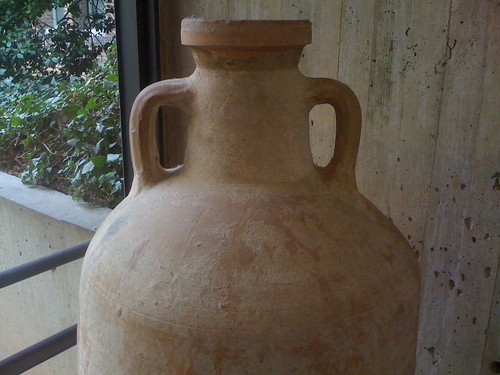
The UPenn Museum of Archaeology and Anthropology has a Late Roman Amphora (L-771-1) on long term loan. In form it's a Keay 62a, a type that was produced from 450 to 600 AD in North Africa. The name is taken from S.J. Keay, (1984), Late Roman Amphorae in the Western Mediterranean. A typology and economic study: the Catalan evidence, BAR Int. Ser. 196, Oxford. [worldcat]. In 1998 Keay updated his chronology for the whole series in his contribution to Lucia Sagui (ed.), Ceramica in Italia: VI-VII Secolo. Atti del Convegno in onore John W. Hayes Roma, 11-13 maggio 1995, Florence [worldcat]. You can find his chapter "Roman Amphorae" on p. 141. M. Bonifay includes observations about the form on p. 137 of his 2004 volume Etudes sur la céramique romaine tardive d’Afrique, BAR Int. Set. 1301, Oxford.[worldcat].

Here are some pictures taken with my iPhone and presented unprocessed except for resizing. You can see that the results are OK for images taken from a distance but blurry for close-ups.


Overview


Close-up of Neck


Side view of handle


Partial view of "button toe"


Close-up of the surface


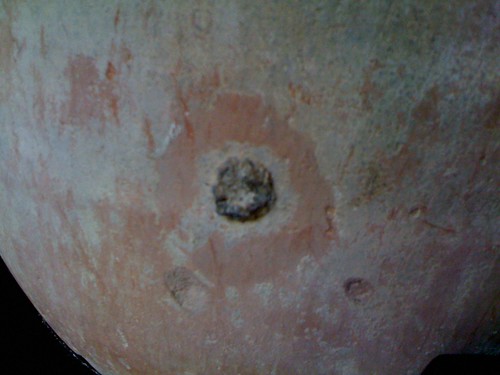
Close-up of plugged hole


The last image of the plugged hole is an opening for further comment. Ted Peña, in his book Roman Pottery in the Archaeological Record [worldcat], follows Bonifay (above, p. 467-8) in listing four methods of holing amphoras that contained liquid commodities. The first consists of:
the creation of one or two small holes ca. 1-2 cm. in diameter, usually by means of a drill, though sometimes by means of punching or chipping, generally in the lower third of the vessel's wall. This method is attested almost exclusively with examples of the Neo-Punic amphora, the "a gradino" variety of the African 2A, and the Keay 25. (p. 67)

The UPenn piece shows such holing in a Keay 62. Of course, we don't know that the vessel was pierced in antiquity and we don't know why the hole was re-filled, or when. It looks like the fill is lead, which certainly could be ancient. It seems likely that something was attached at the point of the hole, perhaps just excess lead. Perhaps not since the marks in the accretion show an incomplete ring as well as distance from the hole. I'm not sure what this means so comments are welcome. And what about the chips below the ring? There's a lot going on here when you take the time to look closely.

One reason to discuss holing of amphoras now is that tomorrow (6/20/2008) is the first day of the conference, "'Pottery in the archaeological record: a view from the Greek world'. A Workshop on J. Theodore Peña’s publication, Roman Pottery in the Archaeological Record", hosted by the Danish Institute at Athens. Consider this post a small contribution to the topic.

I'm grateful to Brian Rose for permission to discuss this piece, and to Lynn Makowsky for accession information.

Wednesday, June 18, 2008

To Dorothy King

Dorothy King is frequently a cogent commentator on matters ancient and modern. But I was unhappy to see her beginning a recent post with:
I sometimes get frustrated with archaeologists who seem to be more worried about preserving every single little broken bit if pot everywhere - and ignore the human cost of war. To some people, the men and women who have given their lives in Afghanistan and Iraq seem to have become theoretical statistics.

To suggest that archaeologists ignore the human cost of the wars in Afghanistan and Iraq is a serious charge and to use "seem" without providing any specific references is unfair.

For my part, I am not so vain as to think she had anything I've written in mind, but I can't help but personalize my response. As a citizen I can express my horror at the human cost by voting, contributing to political campaigns and expressing my opinion. In doing so I am one voice among millions taking part in our pluralistic democracy. As a parent I can teach my three children to honor the service of the troops while disparaging the appointed leaders who have served them so poorly. I do this in my home and usually wouldn't mention it here.

But as an active field-archaeologist and museum professional with direct experience of and expertise in the losses to world cultural heritage wrought the by the international trade in illicit antiquities, I can focus my writings and advocacy on the deleterious effects of these two wars on archaeological knowledge. That this intellectual loss pales in comparison to the human loss should most often be able to go without saying.

To go a step further, I actually think there is a very strong correlation between a focus on the material consequences of the war in Iraq and an understanding that the predictable human cost was one reason to find a better way. To put this differently, I don't personally know archaeologists who strongly supported the war and one basis for their concern was the inevitable loss of life. I am not suggesting a causal relationship: opinions held as a citizen and opinions held as a professional are distinct, but in this case they seem to have overlapped. Since I take this step on the basis of anecdote and conversation, I can't directly cite my sources.

So, I'll stand up for archaeologists as caring as much as any other group of citizens about the human costs of war. When acting as archaeologists, however, we will speak to what we know best, which is the consequences of war for our chosen profession.

Monday, June 16, 2008

"Stolen Artifacts Returned to Iraq"

That's the headline of a brief NYTimes article. Here are the opening sentences:
A cache of ancient artifacts stolen from the National Museum of Iraq during the American-led invasion in 2003 were returned to Iraq’s Antiquities Ministry on Monday in a ceremony in Baghdad, Reuters reported. The items, 11 cylinder seals made from agate and alabaster between 3,000 and 2,000 B.C., were found in Philadelphia last month by American customs officials and turned over to the Iraqi embassy in Washington, a spokesman for the ministry said.
Those of us interested in the legitimate protection of the world's cultural property have realized that looting and theft in Iraq feeds the international market in illicit antiquities. While it is unfortunate that this story proves us right, it is a counter-balance to those who discount such a connection. As an example of such thought I offer this post from Peter Tompa and its admonition to:
watch out for claims that the long-promised 'tidal wave' of looted Iraqi material has finally left its secret warehouses for our shores!

Does the Times story describe a tidal wave washing back to Iraq? No. But add in the Syrian return mentioned there, along with what looks like an upcoming return from Jordan predicted in the Reuters version, and it's hard to justify the lighthearted approach to the problem of stolen Iraqi property taken in Tompa's "Cultural Property Observer".

Coins on the Move

The ANS has moved all its coins and other objects. I mention this because the whole event got coverage in the New York Times. Check out the photo essay as well.

My contribution to this process was only the design of the database we used to track all the crates and their contents. My colleagues did all the heavy lifting.

Thursday, June 12, 2008

Tuesday, June 10, 2008

"Earliest Church" in Jordan

Dorothy King, among others, notes reports of an early church in Jordan. A first century date is almost certainly too early for the pottery shown:

Those look to be amphora necks near in form to Late Roman Amphora 1 from Cilicia or Cyprus. As also indicated by their reasonably good preservation, they should date from the late Roman use of the church and have little to do with any earlier phase.

So... that's a great illustration but is misplaced to the extent that lay-people might think it shows early Roman (let alone "Christian") pottery.

Thursday, June 5, 2008

More on Barrington Atlas IDs and a Question

Sean Gilles has blogged about deriving unique representations of geographic names from the Barrington Atlas.

He suggests the pattern:
http://pleiades.stoa.org/batlas/{label-normalized}-{map}-{grid}

See the complete post for how to transliterate names containing non-ASCII characters into URL friendly (near) equivalents. It's mostly simple: 'Ağva' becomes 'agva' but there are more interesting cases.

Quick question: should the host component of the url be 'pleiades.stoa.org' or 'atlantides.org'? This may not matter from a redirection point-of-view but consistency, searchability, and interchange issues might make it desirable to designate one or the other as the preferred form.

Wednesday, June 4, 2008

Mapping GRBPIlion

I continue to be interested in using the Atom Syndication Format, Georss, KML and Google's mapping tools to express the geographic component of data related to the ancient Mediterranean. These formats are all simple, well-documented and xml-based so that Greek, Roman and Byzantine Pottery at Ilion (Troia), in which we try to use open standards, is a good test-bed for trying out ideas.

To cut to the chase, the following URLs show what I'm up to:Clicking on the Google Maps link shows a browser-embedded map with a short list of sites on the left. It's early yet, but that list will expand. Regardless, clicking on a site name on the left will bring up a text-bubble pointing to the right place on the map. Within the bubble are one or more links to relevant pages on the GRBPIlion website. Imagine more dots and you get the idea.

The implementation is pretty simple but should give me flexibility going forward. There are three basic components. The file "geography.atom" defines geographic entities. If you look inside you'll see that I derive unique IDs from the Barrington Atlas, so Gaza is "http://atlantides.org/batlas/gaza-70-e2". In doing so, I follow the suggestions of Tom Elliot of ISAW. Looking inside "groups.xml" - which instantiates concepts such as "African Red Slip" for rendering into html - shows that a few such groups make reference to these geographic entities. Search for 'rel="geographic"' to see what I mean. Finally, I munge those two files into "grbpilion.kml", which can be shown directly in Google Earth or via Google Maps using the URLs listed above.

The xslt that does the munging is "kml.xsl". It's pretty ugly right now but it works so will do for the short term.

At a more abstract level, I can theoretically put elements such as '<link rel="geographic" href="http://atlantides.org/batlas/gaza-70-e2" />' anywhere in the publication. Right now I only implement this idea in groups.xml but I look forward to extending this system to individual sherd descriptions and to the bibliography.

Friday, May 16, 2008

GRBPIlion and Worldcat.org

[Updated thanks to Susan Heath, who caught a substantive error in my description of the inbibrec element.]

Where possible, I have added links to Worldcat.org for books in the bibliography of Greek, Roman and Byzantine Pottery at Ilion (Troia), the volume I edit with Billur Tekkök.

I probably should have been doing this all along... It was a little boring to play catch-up... But it will now be easy to keep on top of the task as I go forward.

A word on format. Here's the xml I use for Fleischer et al. 2001. Late Antiquity: art in context [worldcat]:

<bibrec id="FleischerJLundJ2001">
<editor>
<first>Jens</first>
<last>Fleischer</last>
</editor>
<editor>
<first>John</first>
<last>Lund</last>
</editor>
<editor>
<first>Marjetta</first>
<last>Nielsen</last>
</editor>
<title>Late Antiquity: art in context</title>
<date>2001</date>
<series>Acta Hyperborea</series>
<volume>8</volume>
<city>Aarhus</city>
<publisher>Museum Tusculanum Press</publisher>
<link rel="url" href="http://books.google.com/books?id=1uc0DHSHUSYC" />
<link rel="worldcat" href="http://www.worldcat.org/oclc/45813395" />
</bibrec>
This volume is in the bibliography because it includes the chapter "The stamped decoration on Phocaean red slip ware" by L. Vaag on p. 215. The xml for this chapter is:

<bibrec id="VaagL2001">
<inbibrec idref="FleischerJLundJ2001"/>
<author>
<first>Leil</first>
<last>Vaag</last>
</author>
<title>The stamped decoration on Phocaean red slip ware</title>
<date>2001</date>
<pages>215-232</pages>
</bibrec>
The inbibrec element of the chapter record, whose idref attribute equals the value of the id attribute of the volume record, creates the link between the two.

It is very true that this xml adheres to no standard. It's my own creation. When I started encoding bibliographic data in xml, I was unsatisfied with all the options so I made up my own. I'm sure I'll move to a standard when one that is granular, lightweight and easy to encode comes along. But sticking to what's current now, combining the two xml records via an xslt stylesheet leads to html such as this.

My one current concession to somewhat standard markup is the link element by which I instantiate the connection to the Worldcat record and to the Google Books version of this volume. This element originated in html and is now used in the Atom Syndication format. I use it as a lightweight encoding for noting multiple relevant internet resources for the volume's record. You can see those links rendered in html here. Next I'll make those links show up in the chapter's html page.

For those who care, I'm tempted to use Atom as a wrapper for the individual bibliographic records. I could even use georss to make the bibliography mappable. That could be cool.

Thursday, May 15, 2008

Numismatic Geography

I attended a workshop yesterday on digital geography at NYU's Institute for the Study of the Ancient World. It was billed as a hackfest and the participants focused on strategies for interoperability of geographic datasets, which is a primary concern of the Concordia Project. My contribution was discussion of the work I'm doing at the American Numismatic Society to provide a geographic infrastructure for accessing our collection. The most concrete result of this work is an incipient list of "geographic entities" that are linked into the ANS database. Here's a sampling of URL's that make this list actually usable:
If you open any of these links and click on one of the symbols, you will see a link to a URL similar to http://numismatics.org/id/1. The resulting page is a little spare but it points to a future in which the ANS establishes unique identifiers for conceptual entities of numismatic interest. In this case, Patara is a geographic entity that is also a mint. "Mint" is an ambiguous term but that's a discussion for another context. What matters is that the ANS now has a simple syntax for establishing identity. Such identities can be linked to third party authority lists, in this case the Pleiades definitions of ancient places. Anybody else using that identifier can know that s/he is referring to the same concept as is the ANS when we say, "Here is a list of coins from Patara." That is a huge step forward.

These id URLs can also be extended with ".atom" and ".kml" to produce an automatically parseable Atom feed or Google Earth compatible representation for each entity. A further implication of this is that I can show maps in the search results produced by the ANS database. If you scroll down in http://numismatics.org/collection/accnum/list?region=cyrenaica&imageavailable=yes, you'll see a "show map" button for the records from Cyrene. Click there for the relevant Google Map.

The NYU/ISAW workshop provided an incentive to get this infrastructure up and running on a preliminary basis. I'm grateful for that and for the hospitality of our hosts. It was an enjoyable day all round!

Monday, May 12, 2008

CAG 66: Les Pyrénées-Orientales

My copy of Carte Archéologique de la Gaule: Les Pyrénées-Orientales (66) edited by J. Kotarba, G. Castellvi and F. Maziere arrived recently from Amazon.fr [worldcat]. The CAG series describes each volume as a "pré-inventaire archéologique" but there is some modesty in this. While it's true that most of the entries are brief, the introductory thematic overviews are usually first rate and the information in each volume is so up-to-date at the time of publication that they are essential research tools.

CAG Les Pyrénées-Orientales continues the trend of increasing use of color images and this is very welcome. Overall, the volume is excellent and there is something for everyone to enjoy. Do you like inscriptions? Check out the color image of a lead tablet discoverd in 2003 and inscribed with incompetent Greek (p. 250). Or the series of Roman-period inscribed pots, known since 1958, which may represent the trash from a tavern (p. 504). I particularly enjoyed the review of work at Ruscino near Perpignan. There is a Visigothic component here as well as an Islamic settlement dating to the 8th century, as indicated by the presence of lead seals with Arabic legends (p. 471-473). For its part, the overview of underwater discoveries pulls together information that is scattered in many publications (p. 622-641).

It takes patience to makes one's way through a CAG volume. The reward is finding something interesting that you might otherwise have missed, like the six nomismata Byzantine weight illustrated on p. 281. It comes from a site at which African Red-Slip was recorded, including the 5th to 6th century form Hayes 87.

Thursday, May 1, 2008

Psalmodi in France

After a long hiatus, my colleague David Yoon and I are turning our attention to the website of the Williams College Excavations at Psalmodi, France. It currently has the aesthetic of an earlier Internet age but there is a lot of good content there, with more to come. As an example of what's there now, the ceramic pages currently include:It will be good to get back to this material.

Wednesday, April 30, 2008

Mediterranean Ceramics Reference Stability Report, Number 7

The MCRSR first appeared in October, 2007. For the seventh installment I am making one addition, no. 18, Roman Amphorae: a digital resource from the United Kingdom Arts and Humanities Data Service's Archaeological Data Service. Astute readers will note that the URL I use re-directs to a interstitial page that asks for compliance with a Copyright and Liability Statement and with a Common Access Agreement. I don't usually use redirects but in this case I do because the publication explicitly asks that citation be only to this URL. It is helpful when sites specify a citation form so that I am happy to comply. But see below for comments on an unfortunate side effect of the site enforcing compliance in this way. In general, however, this is an excellent resource that is highly recommended to anyone interested in the topic. There is much to say about the high quality of the scholarly content but for now I'll keep myself to just a few technically-oriented comments.

First, the title of the work gives me an opportunity to highlight a personal bugaboo of mine. Many digital resources qualify themselves by prepending "electronic" to their titles. This is a misnomer as electricity is only one component of their storage and transmission. Plastics, light, magnetism, etc. are all involved so "digital" is a better term. But this is a somewhat petty observation that doesn't apply here so I'll move on quickly.

About that compliance page, it seems to come at a high cost. If one clicks past the page and makes one's way to the entry for Africana 1 Picolo amphoras, you can read the phrase "Production is attested at Ariana near Carthage...". Try searching for it in Google and you won't find anything. I don't think this can be due to the format of the URL for that particular page - http://ads.ahds.ac.uk/catalogue/archive/amphora_ahrb_2005/details.cfm?id=1 - because Google usually handles such strings with no problem. Rather, I'm guessing that any links to this page first run the Google spider through the compliance page and that interferes with indexing. Regardless of cause, the result is that these superb pages are not discoverable via search engines. That is unfortunate. And having read both the Copyright and Liability statement and the Common Access Agreement, they did not strike me as so unique as to require this intrusion. To put it another way, what benefit is worth that cost?

Readers may be aware that the AHDS' funding will soon run out. Fortunately, as announced on its website, ADS funding will continue. It will be interesting to see if the published URLs of ADS resources change.

There has been one significant change for the previously listed URLs. The JSTOR link to Robinson's Agora V is now http://www.jstor.org/stable/i285178. Unfortunately, the previous URL, http://links.jstor.org/sici?sici=1558-8610%281959%295%3C%3E1.0.CO%3B2-3, no longer works. And to compound the issue, the new URL takes one to a login page that does not indicate the title of the linked work. This is an unexpected situation that I hope results from temporary errors. One reason to think they are temporary is that there are "old style" URLs that do redirect to the new and improved URL format. For example, http://links.jstor.org/sici?sici=0002-9475(1949)70%3A3%3C299%3APPFATT%3E2.0.CO%3B2-S remains usable.


1. Walters' Catalogue of the Roman Pottery in the Departments of Antiquities, British Museum from Google Books: http://books.google.com/books?id=M2UEAAAAYAAJ

2. Robinson's Agora V from JSTOR: http://www.jstor.org/stable/i285178, previously http://links.jstor.org/sici?sici=1558-8610%281959%295%3C%3E1.0.CO%3B2-3

3. Lattara 6: http://www.lattara.net/LATTARAPUB/PUBLAT/LATTARA6/lattara6.html

4. K. Greene's AJA article on Early Roman lead glazed pottery: http://www.ajaonline.org/pdfs/111.4/AJA1114_Greene.pdf

5. Heath and Tekkök, Greek, Roman and Byzantine Pottery at Ilion (Troia): http://classics.uc.edu/troy/grbpottery/

6. Vessel from Çatalhoyuk (via Flickr): http://www.flickr.com/photos/catalhoyuk/971964416/

7. A Late Minoan III Pyxis from the Metropolitan Museum of Art: http://www.metmuseum.org/toah/ho/03/eus/hod_1999.423.htm

8. An undocumented ARS Hayes 70 bowl from the dealer Classical Numismatics Group: http://cngcoins.com/Coin.aspx?CoinID=86618

9. Fifteenth Century Mosque Lamp from Jerusalem now in the British Museum: http://www.britishmuseum.org/explore/highlights/highlight_objects/me/m/mosque_lamp.aspx

10. The Perseus Project Vase Catalog: http://www.perseus.tufts.edu/cgi-bin/ptext?doc=Perseus%3Atext%3A1999.04.0043

11. Wikimedia Commons Image of a Greek Geometric Skyphos in the Louvre: http://commons.wikimedia.org/wiki/Image:Skyphos_birds_Louvre_CA3822.jpg

12. Sagalassos from Pleiades: http://pleiades.stoa.org/places/639087

13. Inscribed pot from Aphrodisias (HTML): http://insaph.kcl.ac.uk/iaph2007/iAph150353.html

14. Inscribed pot from Aphrodisias (XML): http://insaph.kcl.ac.uk/iaph2007/xml/iAph150353.xml

15. Hellenistic lamp from Assos, Turkey at the Museum of Fine Arts, Boston: http://mfa.org/collections/search_art.asp?recview=true&id=199476&coll_keywords=&coll_accession=84%2E110&coll_name=&coll_artist=&coll_place=&coll_medium=&coll_culture=&coll_classification=&coll_credit=&coll_provenance=&coll_location=&coll_has_images=&coll_on_view=&coll_sort=2&coll_sort_order=0&coll_view=0&coll_package=0&coll_start=1

16. Open Context record for Halaf period jar from Domuztepe, Turkey: http://www.opencontext.org/database/space.php?item=14926_DT_Spatial

17. Abbasid Ceramics from the Museum With No Frontiers: http://www.discoverislamicart.org/exhibitions/ISL/the_abbasids/exhibition.php?theme=5

18. Roman Amphorae: a digital resource: http://ads.ahds.ac.uk/catalogue/resources.html?amphora2005

Dining and Numismatic Imagery

I've added a preliminary discussion of Roman New Years lamps to the ongoing draft of Dining and Numismatic Imagery. I've had a few discussions with colleagues on this topic but until I am better able to incorporate their thoughts, I won't name names so as to protect the innocent. I gladly take responsibility for all mistakes and welcome them being pointed out.

Thursday, April 24, 2008

Dining and Numismatic Imagery

I am putting myself in position to make more progress on the dining and numismatic imagery article. I decided is was unfeasible to write directly in the blogger interface. So I've moved the text into xhtml and made it available on my personal website. The URL is http://sebastianheath.com/documents/dining2008.html. It's pretty much the same as before with just a few additions, perhaps fewer typos, more of the links actually work, etc.

I link back to this post and welcome more comments, though I will be making significant changes "real soon now".

Monday, April 21, 2008

Looting and Westphalian Sovereignty

David Gill's Looting Matters and Saving Antiquities for Everyone's SAFE Corner are the "go to" blogs for cultural property issues. In a recent post, Gill comments on James Cuno's recently published essay "Who Owns the Past?", which can be found on the Yale Global Online web site.

I endorse the whole post and quote just the closing paragraphs:
Do we care about the destruction of sixth century BCE tombs in the Republic of Macedonia to supply antiquities for, say, private collectors?

Yes.

Not because of "nationalist retentionist cultural property laws" (though I could understand a call by archaeologists working in the Republic of Macedonia for the return of specific pieces) but because looting is destroying some unique and highly significant archaeological contexts—and that destruction is removing part of human knowledge for ever.

Looting has intellectual consequences.
Looking at Cuno's article directly, it seems to me that the following passage offers archaeologists flawed advice on the basis of an uneven conception of the role of national sovereignty:
Archaeologists should work with museums to counter the nationalist basis of laws, conventions and agreements, and promote a principle of shared stewardship of our common heritage. Together we should call attention to the failure of these laws to protect our common ancient heritage and perversion of that heritage by claiming the archaeological record as a modern nation’s cultural property[.]
For a modern nation state to claim the archaeological record as cultural property is not a perversion but rather a commonplace application long-standing claims of national prerogative. I use the historical term "Westphalian Sovereignty" to highlight one source of this prerogative: the set of treaties that brought an end to many decades of European war in 1648. Historical debates about the origins of our current international system notwithstanding, nations have since at least that time acted either individually or collectively to address issues of global concern. The system is imperfect, to be sure, but has so far allowed us all to avoid global armageddon while holding out hope for general progress and improvement.

Why then are we asked to carve out an exception when it comes to cultural property and to offer a safe haven from national sovereignty to those who would participate, whether directly or indirectly, in the evident and ongoing looting of global cultural heritage? This makes no sense to me.

As an aside, I am reminded of the time I was a delegate at the 2006 ACLS annual meeting in Philadelphia. During the program, the then Deputy Chairman of the NEH spoke and offered similar arguments about the disjunction between national sovereignty and universal cultural heritage. I was struck by the incongruence of a public servant - an individual whose salary was paid because the sovereign government of the United States chose to compel its citizens both to pay taxes and to take on common debt - standing in front of the American Council of Learned Societies - an organization explicitly organized along national lines - in order to question a state such as Italy's choice to exercise its sovereignty in the protection of material property inside its national boundaries. That seemed odd at best.

To return to Cuno's article, arguments that rely on a unique safe-haven from national sovereignty for the trade in antiquities should be suspect as either arbitrary, self-serving or both.