Monday, April 21, 2008
Ceramics at the Museum of London
I had not seen the online presentation of the ceramics collection of the Museum of London. I particularly enjoyed the amphora section: many Dressel 20's, a Richborough 527, Late Roman 4's. Keep clicking, there's much to see. Put this next to the Roman Amphorae: a digital resource and it's clear that amphora specialists - at least the Roman ones - share their data more than most.


Friday, April 4, 2008
Ecosystems
To review:
There is substantive discussion about what's holding us up. Among the themes I see in the flow of thoughts is "who shares what, how, and why (or why not)?" Charles introduced the metaphor of faunal equivalence and that has caught on. At the substantial risk of mischaracterizing Charles' larger point, he seems to be marking those who do share as exceptional and to focus on why people don't. I mean that as an observation and not as a judgement and I hope to be corrected if wrong.
Bill's latest post expanded on Charles' evocation of the fundamental lack of replicability in the archaeological process by writing:
I do note that Bill also ends on what I take as a positive note:
Hence my title. We already have an entire ecosystem of sharers and it's only going to get more diverse. It doesn't matter what kind of animal you are, as long as your data survives.
So I am an optimist on the basis of quickly formulated principle, on the basis of current observation, and due to the resulting extrapolation of future trends. But I'm a little grumpy, too. If you don't share, you won't matter. Simple as that.
- Charles Watkinson wrote about "drilling-down" in archaeology.
- I responded
- Charles replied.
- Bill Caraher joined in
- Tom Elliot took us into orbit
- Eric Kansa took note
- Bill re-upped
- The whole thread hit the Big Time.
So where next for the dream of seamlessly linked publications and their data in archaeology? Some current trends are encouraging.And his finishing paragraph:
The "drill down" may never be as easy as it sounds, but it is more attainable technologically, intellectually, and politically now than it has ever been in the past. The prospect of linking archaeological publication with the data that inspired it is coming within sight.It's seems clear that we're all looking to a similar future.
There is substantive discussion about what's holding us up. Among the themes I see in the flow of thoughts is "who shares what, how, and why (or why not)?" Charles introduced the metaphor of faunal equivalence and that has caught on. At the substantial risk of mischaracterizing Charles' larger point, he seems to be marking those who do share as exceptional and to focus on why people don't. I mean that as an observation and not as a judgement and I hope to be corrected if wrong.
Bill's latest post expanded on Charles' evocation of the fundamental lack of replicability in the archaeological process by writing:
The valuable cognitive and phenomenological patterns, for example, that comprise an archaeological "sense of place" would form a kind of metadata that does not translate easily into print or digital media.So not just who shares, but, of the archaeology happening at the edge of whatever tool, methodology or metaphor you choose, what are we able to share.
I do note that Bill also ends on what I take as a positive note:
The work of the Grey Panthers and their collaborators will certainly resolve many of these issues in the near future, but for now with all the other pressures of data collection (i.e. archaeological fieldwork), writing, and teaching, we can only do so much toward making our data publicly available electronically. As someone committed to the concept, however, it is my hope that in the near future greater technical and financial resources will make it easier to do the right thing.Let me say that I, too, am an optimist. In part because I take the following sequence to be fairy self-evident:
- We all create at least some data that is either already digital or can be digitized.
- Nobody is going to actively destroy their digital data. (I'll invoke exceptions as proving the rule.)
- We will all make some arrangement to put our data somewhere and this will happen either before or after we're "done" with them ourselves.
In fact, from my perspective here in Greece, the dominant attitude among juniors scholars is frustration that archaeological data is not available. One can only hope that this frustration will be a powerful impetus toward making archaeological material accessible to the scholarly community quickly and openly.Having looked for common ground, I am not afraid of disagreement. My current focus is resolutely on sharing and I see it all around me. On the Stoa, on Open Context, on the Archaeological Data Service, on Wikipedia and its attendant Wikimedia Commons, on Flickr, in the incipient rumblings out of ISAW, from the Center for Hellenic Studies, from the legislative and executive branches of the United States government, from epigraphers, from museums, from numismatists, from big projects going part way, from big projects going all the way, from many other field projects currently dipping their toes into the water via websites and probably inclined to do more, and even - dare I say it - from journals going not nearly far enough. I could go on (and on)...
Hence my title. We already have an entire ecosystem of sharers and it's only going to get more diverse. It doesn't matter what kind of animal you are, as long as your data survives.
So I am an optimist on the basis of quickly formulated principle, on the basis of current observation, and due to the resulting extrapolation of future trends. But I'm a little grumpy, too. If you don't share, you won't matter. Simple as that.
Tuesday, April 1, 2008
Two Publications: SFECAG (2007) and Kyme e l'Eolide
1: I mentioned that Librairie Archéologique sent me a mail order catalog. Included in the envelope was a separate sheet advertising the availability of Actes du congrès SFECAG de Langres, 2007. Here's a direct link to the LibrArch site. If that doesn't work search for the reference 34884. At the moment, the direct link lists the volume as "Indisponible à la vente". I hope that's a temporary shortage as I just got the notice.
But what is SFECAG? The acronym stands for Société Française d'Étude de la Céramique Antique en Gaule. The organization's website is at http://sfecag.free.fr/.
The Society's main activity is the holding of an annual congress and subsequent publication of the papers. Volumes have appeared since 1985. Collectively, the series is a great resource for keeping track of what French ceramicists are up to. Among my favorite articles is L. Rivet et al. (2001). "Les sigillées tardives des fouilles 1946-1970 de Saint-Blaise (Bouches-du-Rhône)," Société Française d’Étude de la Céramique Antique en Gaule: Actes du Congrès de Lille-Bavay, 24-27 Mai 2001. Marseille: 489-515. Among other observations, the authors publish seven sherds of Cypriot Red-Slip from the late Antique phases of this rural site.
These volumes are not well represented in US libraries. If you search for "SFECAG" in Worldcat.org you only get European libraries for the various volumes that are listed. Searching for "Société Française d’Étude de la Céramique Antique en Gaule" and clicking within the resulting list shows some US libraries. But it has not been easy to order these volumes so I'm glad to see LibrArch carrying some of them.
2: Vincenzo di Giovanni has been kind enough to send me an offprint of his article "Ceramica romana e tardo antica di Kyme. Osservazione preliminari sui materiali dagli scavi dell'Università di Napoli 'Frederico II'" found in L. Scatozza Höricht, ed. (2007). Kyme e l'Eolide da Augusto a Costantino. Atti dell'Incontro internazionale di studio Missione archeologica italiana : Napoli, 12-13 dicembre 2005 Naples. I don't have access to the whole volume yet so I'm happy to have this preview. As noted by Dr. Di Giovanni in an e-mail correspondence, the Kyme assemblage overlaps well with what we have at Ilion/Troy. Not ware-for-ware, form-for-form but the two sites are close enough to be part of similar large-scale exchange networks.
But what is SFECAG? The acronym stands for Société Française d'Étude de la Céramique Antique en Gaule. The organization's website is at http://sfecag.free.fr/.
The Society's main activity is the holding of an annual congress and subsequent publication of the papers. Volumes have appeared since 1985. Collectively, the series is a great resource for keeping track of what French ceramicists are up to. Among my favorite articles is L. Rivet et al. (2001). "Les sigillées tardives des fouilles 1946-1970 de Saint-Blaise (Bouches-du-Rhône)," Société Française d’Étude de la Céramique Antique en Gaule: Actes du Congrès de Lille-Bavay, 24-27 Mai 2001. Marseille: 489-515. Among other observations, the authors publish seven sherds of Cypriot Red-Slip from the late Antique phases of this rural site.
These volumes are not well represented in US libraries. If you search for "SFECAG" in Worldcat.org you only get European libraries for the various volumes that are listed. Searching for "Société Française d’Étude de la Céramique Antique en Gaule" and clicking within the resulting list shows some US libraries. But it has not been easy to order these volumes so I'm glad to see LibrArch carrying some of them.
2: Vincenzo di Giovanni has been kind enough to send me an offprint of his article "Ceramica romana e tardo antica di Kyme. Osservazione preliminari sui materiali dagli scavi dell'Università di Napoli 'Frederico II'" found in L. Scatozza Höricht, ed. (2007). Kyme e l'Eolide da Augusto a Costantino. Atti dell'Incontro internazionale di studio Missione archeologica italiana : Napoli, 12-13 dicembre 2005 Naples. I don't have access to the whole volume yet so I'm happy to have this preview. As noted by Dr. Di Giovanni in an e-mail correspondence, the Kyme assemblage overlaps well with what we have at Ilion/Troy. Not ware-for-ware, form-for-form but the two sites are close enough to be part of similar large-scale exchange networks.
Monday, March 31, 2008
Drilling Down (and Up)
Charles Watkinson doesn't blog often, but when he does, he blogs well. His latest post is entitled The "drill down" dilemma. Why can't we link archaeological publication to the underlying data? It's worth reading the whole thing and I have to say that I largely agree with his summary of the current state of affairs. But I do have some reactions that I'll put into words...
First, a little full disclosure: I've known Charles for a long time; he's a good guy and a friend so that this should be seen as a respectful exchange within a longer conversation.
Charles notes that it is difficult to move from works of archaeological synthesis to the original data. I won't paraphrase more than that since you can and should read the original for yourself.
The first explanation/reason he offers for an inability to drill-down is that "Nobody wants to share their data." Taken as a stand-alone statement, this may under-represent the extent to which sharing is already taking place. I'll name names.
Because it shares so much, the Çatalhöyük site allows drill-down. Here's an example. I. Hodder and C. Cessford. 2004. Daily Practice and Social Memory at Çatalhöyük American Antiquity 69.1: 17-40 explores "the social processes involved in the formation of large agglomerated villages in the Neolithic of the Near East and Anatolia, with particular reference to Çatalhöyük in central Turkey." (p. 1). Among other information, work in Buildings 1 and 5 of the North Area is presented with a focus on evidence for variable activities within the distinctly marked spaces in each house (p. 24-21) and also on the presence of individuals buried under house 1 who would have been alive when the earlier and underlying house 5 was in use (fig. 10).
Within the text, analysis of the elemental composition of the floors in Building 5 showed the NW platform to have been distinctive, "probably as the result of both the reuse of different floor materials in the construction of different areas, and as a result of differential use of different parts of the floor." (p. 27-28 and fig. 9). The earlier fig. 3 indicates that this platform lies in front of Feature 230, a north-south running wall. That feature number, usefully published in this interpretive article, is key to drilling down.
The project's website links to the Çatalhöyük Image Database hosted at Stanford. Here we can search for images of Feature 230. For example:
Or:

Humans make good scales and it's nice to see just how cramped the NW platform of Building 5, running from the upside down 4 to the wall, would have been. Seeing these images makes the following passage of high-level synthesis more believable:
Now, I'm pretty sure that Charles would not find what I've said objectionable. I just don't want to let anybody off the hook by not stressing that archaeologists are already sharing, that those doing it are senior, and that there is a technological and legal infrastructure that makes links from interpretive work to source data possible.
Charles also writes of drilling "sideways and upwards". Just for fun, I'll take the concept of drilling "up" to mean moving from data to interpretation. I mean by this doing the opposite of what I did at Çatalhöyük: you're on the website, you see a reference to Feature 230 and you want to find where it's been discussed. As we move forward to the world that Charles envisions, it may be that the tendency of academic journals to use services such as JSTOR and Atypon will impede the ability of scholars to drill-up. Certainly, anyone not associated with a subscribing library would not be able to access American Antiquity. It also seems that the commercial imperatives of JSTOR and Atypon, as well as of their contributing journals, are interfering with any moves to make article text available in useful formats, i.e. not as unduly encumbered PDFs or poorly structured texts. One hopes that this will change. Drilling in all directions will be increasingly important for future academic efforts.
First, a little full disclosure: I've known Charles for a long time; he's a good guy and a friend so that this should be seen as a respectful exchange within a longer conversation.
Charles notes that it is difficult to move from works of archaeological synthesis to the original data. I won't paraphrase more than that since you can and should read the original for yourself.
The first explanation/reason he offers for an inability to drill-down is that "Nobody wants to share their data." Taken as a stand-alone statement, this may under-represent the extent to which sharing is already taking place. I'll name names.
- Martha Joukowsky, Emeritus Professor of Anthropology at Brown University and former President of Archaeological Institute of America shares data from her excavation at Petra. A large dataset is available on the OpenContext website.
- Jack Davis, Carl W. Blegen Professor of Greek Archaeology at the University of Cincinnati and current Director of the American School of Classical Studies at Athens, shares data from the Pylos Regional Archaeological Project. See under "Project Databases" in the Table of Contents. I work on this project and as I've noted we are beginning to make the data available under a Creative Commons license. See the website for the other project directors and participants who are likewise sharing.
- I also share my work with Billur Tekkök, Associate Professor at Başkent University, on pottery at Troy. By implication then, Brian Rose, James B. Pritchard Professor of Archaeology at the University of Pennsylvania and current President of the Archaeological Institute of America, shares since we confirmed with him that it was OK to distribute our work under a Creative Commons license.
- Ian Hodder, Dunlevie Family Professor of Anthropology at Stanford, also shares. The entire Çatalhöyük website is published under a Creative Commons Attribution - Non-Commercial - Share Alike license. That's about as generous as you can be.
Because it shares so much, the Çatalhöyük site allows drill-down. Here's an example. I. Hodder and C. Cessford. 2004. Daily Practice and Social Memory at Çatalhöyük American Antiquity 69.1: 17-40 explores "the social processes involved in the formation of large agglomerated villages in the Neolithic of the Near East and Anatolia, with particular reference to Çatalhöyük in central Turkey." (p. 1). Among other information, work in Buildings 1 and 5 of the North Area is presented with a focus on evidence for variable activities within the distinctly marked spaces in each house (p. 24-21) and also on the presence of individuals buried under house 1 who would have been alive when the earlier and underlying house 5 was in use (fig. 10).
Within the text, analysis of the elemental composition of the floors in Building 5 showed the NW platform to have been distinctive, "probably as the result of both the reuse of different floor materials in the construction of different areas, and as a result of differential use of different parts of the floor." (p. 27-28 and fig. 9). The earlier fig. 3 indicates that this platform lies in front of Feature 230, a north-south running wall. That feature number, usefully published in this interpretive article, is key to drilling down.
The project's website links to the Çatalhöyük Image Database hosted at Stanford. Here we can search for images of Feature 230. For example:
Or:
Humans make good scales and it's nice to see just how cramped the NW platform of Building 5, running from the upside down 4 to the wall, would have been. Seeing these images makes the following passage of high-level synthesis more believable:
Taking the past and present excavations together, there is evidence to suggest that as a child grew up in a house at Çatalhöyük, it would have learned that different types of people were buried beneath certain platforms, that different plasters were used for different platforms, and that refuse was swept up more carefully from some areas... Social rules would have been learned through daily practice involving the movements of the body in the house. This is one way in which each indvidual would have learned and incorporated social rules. (p. 30)To be sure, the drill-down wasn't effortless; I had to put quite some time into figuring out the image database. The "Aha!" moment came when I noticed the link between it and the numbers used in the article. But the idea is there. Sharing data improves ones ability to test and appreciate hypotheses presented in secondary literature.
Now, I'm pretty sure that Charles would not find what I've said objectionable. I just don't want to let anybody off the hook by not stressing that archaeologists are already sharing, that those doing it are senior, and that there is a technological and legal infrastructure that makes links from interpretive work to source data possible.
Charles also writes of drilling "sideways and upwards". Just for fun, I'll take the concept of drilling "up" to mean moving from data to interpretation. I mean by this doing the opposite of what I did at Çatalhöyük: you're on the website, you see a reference to Feature 230 and you want to find where it's been discussed. As we move forward to the world that Charles envisions, it may be that the tendency of academic journals to use services such as JSTOR and Atypon will impede the ability of scholars to drill-up. Certainly, anyone not associated with a subscribing library would not be able to access American Antiquity. It also seems that the commercial imperatives of JSTOR and Atypon, as well as of their contributing journals, are interfering with any moves to make article text available in useful formats, i.e. not as unduly encumbered PDFs or poorly structured texts. One hopes that this will change. Drilling in all directions will be increasingly important for future academic efforts.
Sunday, March 30, 2008
JRA from Librairie Archéologique
I received a printed catalog from Librairie Archéologique today. I occasionally use their website to order French books so I've made it on to their mailing list. This isn't really news, of course.
It was surprising to find volume 20 of the Journal of Roman Archaeology offered on page one of the catalog for the price of 180.00 Euros. According to XE.com, that's $284.35! The JRA's own website gives a list price of $135.00 and an individual price of $68.75 + shipping. No matter how you calculate it, that's a steep markup.
Perhaps the most telling part of seeing this price was guessing that it's not a typo. Between the dollar being so low and European books being so expensive, it's probably pretty easy to get to that number.
I suppose my point is that in a world of overpriced books, it's still worth commenting when the system for distributing printed information so clearly mis-serves its audience.
Or maybe it is just a typo. If so, I can always be outraged that D. and N. Soren's A Roman Villa and a Late Roman Infant Cemetery: excavation at Poggio Gramignano, Lugnano in Teverina costs $608.00 from Amazon.com. As of writing, there are only two left in stock so get it while you can!
It was surprising to find volume 20 of the Journal of Roman Archaeology offered on page one of the catalog for the price of 180.00 Euros. According to XE.com, that's $284.35! The JRA's own website gives a list price of $135.00 and an individual price of $68.75 + shipping. No matter how you calculate it, that's a steep markup.
Perhaps the most telling part of seeing this price was guessing that it's not a typo. Between the dollar being so low and European books being so expensive, it's probably pretty easy to get to that number.
I suppose my point is that in a world of overpriced books, it's still worth commenting when the system for distributing printed information so clearly mis-serves its audience.
Or maybe it is just a typo. If so, I can always be outraged that D. and N. Soren's A Roman Villa and a Late Roman Infant Cemetery: excavation at Poggio Gramignano, Lugnano in Teverina costs $608.00 from Amazon.com. As of writing, there are only two left in stock so get it while you can!
Friday, March 28, 2008
Mediterranean Ceramics Reference Stability Report, Number 6
The MCRSR first appeared in October, 2007. For the sixth installment, I am again making only one addition, no. 17, the section "Abbassid Ceramics" in the Discover Islamic Art exhibition from the Museum With No Frontiers. This is a very well done website that has received substantial European Union and other funding. It will be interesting to see if the information it offers remains available over the long term.
The previously listed URLs for MCRSR items 1 through 16 remain valid. At the time of writing, I can't access number 3, Lattara 6, but I believe this is only a temporary disruption.
Number 10, the Perseus Vase Catalog, announces that "Perseus is changing! Please visit Perseus 4.0 for the current version". The new URL is http://www.perseus.tufts.edu/hopper/text.jsp?doc=Perseus:text:1999.04.0043. At some point, it may be appropriate to update item 10, but for now I am going to hold off until the current URL becomes invalid.
1. Walters' Catalogue of the Roman Pottery in the Departments of Antiquities, British Museum from Google Books: http://books.google.com/books?id=M2UEAAAAYAAJ
2. Robinson's Agora V from JSTOR: http://links.jstor.org/sici?sici=1558-8610%281959%295%3C%3E1.0.CO%3B2-3
3. Lattara 6: http://www.lattara.net/LATTARAPUB/PUBLAT/LATTARA6/lattara6.html
4. K. Greene's AJA article on Early Roman lead glazed pottery: http://www.ajaonline.org/pdfs/111.4/AJA1114_Greene.pdf
5. Heath and Tekkök, Greek, Roman and Byzantine Pottery at Ilion (Troia): http://classics.uc.edu/troy/grbpottery/
6. Vessel from Çatalhoyuk (via Flickr): http://www.flickr.com/photos/catalhoyuk/971964416/
7. A Late Minoan III Pyxis from the Metropolitan Museum of Art: http://www.metmuseum.org/toah/ho/03/eus/hod_1999.423.htm
8. An undocumented ARS Hayes 70 bowl from the dealer Classical Numismatics Group: http://cngcoins.com/Coin.aspx?CoinID=86618
9. Fifteenth Century Mosque Lamp from Jerusalem now in the British Museum: http://www.britishmuseum.org/explore/highlights/highlight_objects/me/m/mosque_lamp.aspx
10. The Perseus Project Vase Catalog: http://www.perseus.tufts.edu/cgi-bin/ptext?doc=Perseus%3Atext%3A1999.04.0043
11. Wikimedia Commons Image of a Greek Geometric Skyphos in the Louvre: http://commons.wikimedia.org/wiki/Image:Skyphos_birds_Louvre_CA3822.jpg
12. Sagalassos from Pleiades: http://pleiades.stoa.org/places/639087
13. Inscribed pot from Aphrodisias (HTML): http://insaph.kcl.ac.uk/iaph2007/iAph150353.html
14. Inscribed pot from Aphrodisias (XML): http://insaph.kcl.ac.uk/iaph2007/xml/iAph150353.xml
15. Hellenistic lamp from Assos, Turkey at the Museum of Fine Arts, Boston: http://mfa.org/collections/search_art.asp?recview=true&id=199476&coll_keywords=&coll_accession=84%2E110&coll_name=&coll_artist=&coll_place=&coll_medium=&coll_culture=&coll_classification=&coll_credit=&coll_provenance=&coll_location=&coll_has_images=&coll_on_view=&coll_sort=2&coll_sort_order=0&coll_view=0&coll_package=0&coll_start=1
16. Open Context record for Halaf period jar from Domuztepe, Turkey: http://www.opencontext.org/database/space.php?item=14926_DT_Spatial
17. Abbasid Ceramics from the Museum With No Frontiers: http://www.discoverislamicart.org/exhibitions/ISL/the_abbasids/exhibition.php?theme=5
The previously listed URLs for MCRSR items 1 through 16 remain valid. At the time of writing, I can't access number 3, Lattara 6, but I believe this is only a temporary disruption.
Number 10, the Perseus Vase Catalog, announces that "Perseus is changing! Please visit Perseus 4.0 for the current version". The new URL is http://www.perseus.tufts.edu/hopper/text.jsp?doc=Perseus:text:1999.04.0043. At some point, it may be appropriate to update item 10, but for now I am going to hold off until the current URL becomes invalid.
1. Walters' Catalogue of the Roman Pottery in the Departments of Antiquities, British Museum from Google Books: http://books.google.com/books?id=M2UEAAAAYAAJ
2. Robinson's Agora V from JSTOR: http://links.jstor.org/sici?sici=1558-8610%281959%295%3C%3E1.0.CO%3B2-3
3. Lattara 6: http://www.lattara.net/LATTARAPUB/PUBLAT/LATTARA6/lattara6.html
4. K. Greene's AJA article on Early Roman lead glazed pottery: http://www.ajaonline.org/pdfs/111.4/AJA1114_Greene.pdf
5. Heath and Tekkök, Greek, Roman and Byzantine Pottery at Ilion (Troia): http://classics.uc.edu/troy/grbpottery/
6. Vessel from Çatalhoyuk (via Flickr): http://www.flickr.com/photos/catalhoyuk/971964416/
7. A Late Minoan III Pyxis from the Metropolitan Museum of Art: http://www.metmuseum.org/toah/ho/03/eus/hod_1999.423.htm
8. An undocumented ARS Hayes 70 bowl from the dealer Classical Numismatics Group: http://cngcoins.com/Coin.aspx?CoinID=86618
9. Fifteenth Century Mosque Lamp from Jerusalem now in the British Museum: http://www.britishmuseum.org/explore/highlights/highlight_objects/me/m/mosque_lamp.aspx
10. The Perseus Project Vase Catalog: http://www.perseus.tufts.edu/cgi-bin/ptext?doc=Perseus%3Atext%3A1999.04.0043
11. Wikimedia Commons Image of a Greek Geometric Skyphos in the Louvre: http://commons.wikimedia.org/wiki/Image:Skyphos_birds_Louvre_CA3822.jpg
12. Sagalassos from Pleiades: http://pleiades.stoa.org/places/639087
13. Inscribed pot from Aphrodisias (HTML): http://insaph.kcl.ac.uk/iaph2007/iAph150353.html
14. Inscribed pot from Aphrodisias (XML): http://insaph.kcl.ac.uk/iaph2007/xml/iAph150353.xml
15. Hellenistic lamp from Assos, Turkey at the Museum of Fine Arts, Boston: http://mfa.org/collections/search_art.asp?recview=true&id=199476&coll_keywords=&coll_accession=84%2E110&coll_name=&coll_artist=&coll_place=&coll_medium=&coll_culture=&coll_classification=&coll_credit=&coll_provenance=&coll_location=&coll_has_images=&coll_on_view=&coll_sort=2&coll_sort_order=0&coll_view=0&coll_package=0&coll_start=1
16. Open Context record for Halaf period jar from Domuztepe, Turkey: http://www.opencontext.org/database/space.php?item=14926_DT_Spatial
17. Abbasid Ceramics from the Museum With No Frontiers: http://www.discoverislamicart.org/exhibitions/ISL/the_abbasids/exhibition.php?theme=5
Tuesday, March 25, 2008
Roman Pottery at Caerleon
The website of the National Museum Wales has a nice page on the Roman Pottery at Caerleon. Although brief, the text and images raise such wide ranging issues as military supply, ancient literacy and modes of archaeological reasoning. Be sure to read the captions on the images.
The overlap between roman military studies and ceramic studies is of long standing. Remaining in the British Isles, chapter 11 of the online version of J. Curle's 1911 A Roman Frontier Post and its People: The Fort of Newstead in the Parish of Melrose briefly surveys the use of military history to establish ceramic chronology as understood at the time. That text is out of date, of course. See the Potsherd site for more current thinking.
Wales is at one edge of the cultural ambit of the ancient Mediterranean world. Jumping to the east, the 2005 JRA supplement Excavations on the site of Jerusalem International Convention Center (Binyanei Ha'Uma) has added an interesting data point to the discussion of legionary ceramic supply during the Hadrianic and Antonine periods in ancient Palestine. Jodi Magness' Chapter 7 on the pottery from kilns associated with the presence of Legio X in Jerusalem has a conclusion (p. 104) that cites further bibliography. Earlier, she writes that "petrographic analysis has indicated that all of the pottery from the site is made of Motza clay or local Terra Rosa soil and was therefore produced in Jerusalem." (p. 70) This statement is based on work by Yuval Goren described on p. 193 of the same volume. These results are surprising given the range of types cataloged, which includes slipped tablewares, thin-walled wares, and utilitarian vessels. As Magness notes, "without petrographic analysis, we might have assumed that the pottery at the convention site is imported." (p. 106). She goes on to suggest that two or more of the potters had worked on the Rhine or Danube frontiers. It is interesting work that highlights the distinctive nature of Roman military supply.
The overlap between roman military studies and ceramic studies is of long standing. Remaining in the British Isles, chapter 11 of the online version of J. Curle's 1911 A Roman Frontier Post and its People: The Fort of Newstead in the Parish of Melrose briefly surveys the use of military history to establish ceramic chronology as understood at the time. That text is out of date, of course. See the Potsherd site for more current thinking.
Wales is at one edge of the cultural ambit of the ancient Mediterranean world. Jumping to the east, the 2005 JRA supplement Excavations on the site of Jerusalem International Convention Center (Binyanei Ha'Uma) has added an interesting data point to the discussion of legionary ceramic supply during the Hadrianic and Antonine periods in ancient Palestine. Jodi Magness' Chapter 7 on the pottery from kilns associated with the presence of Legio X in Jerusalem has a conclusion (p. 104) that cites further bibliography. Earlier, she writes that "petrographic analysis has indicated that all of the pottery from the site is made of Motza clay or local Terra Rosa soil and was therefore produced in Jerusalem." (p. 70) This statement is based on work by Yuval Goren described on p. 193 of the same volume. These results are surprising given the range of types cataloged, which includes slipped tablewares, thin-walled wares, and utilitarian vessels. As Magness notes, "without petrographic analysis, we might have assumed that the pottery at the convention site is imported." (p. 106). She goes on to suggest that two or more of the potters had worked on the Rhine or Danube frontiers. It is interesting work that highlights the distinctive nature of Roman military supply.
Saturday, March 22, 2008
Ankara and Gordion
This is the first post since hearing of the passing of Ross Scaife, among whose enduring accomplishments is the Stoa. There is something very fitting about this link. So with his legacy in mind...
I am in Ankara after attending Kültürel Mirası Koruma’da Yeni Yöntem ve Uygulamalar Sempozyumu/Symposium of The Preservation of Cultural Heritage: New Methods and Applications. The talks were all interesting and I'm grateful to my Turkish hosts for their hard work in putting the meeting together.
Today a group went to Gordion and to the Museum of Anatolian Civilizations (Wikipedia). This was my first visit to both so it was a great coda to an all-round wonderful trip.
The most impressive monument at Gordion is the so-called "Midas Tomb" (Tumulus MM), visible from the main highway as one drives to and from the site. Midas died c. 695 BC and Peter Kuniholm's dendrochronological investigations have put the cutting-date of the trees in the burial chamber some fifty years earlier. Hence the "so-called". Regardless of date, it's a must see site if you ever get the chance.
The museum is excellent and recently re-installed. The gallery past the opening one holds a series of cases that are generous in their use of pottery to illustrate trends in the history of the city. Flickr has a few illustrative images:

Middle Phrygian Dinos with creatures peeking over the rim.
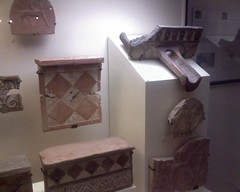
Middle Phrygian Architectural Terracottas

Attic Import
A further note on absolute chronology: As discussed by Mary Voigt (p. 195), the destruction level that had been associated with the Kimmerian invasion and death of Midas has been pushed back to 830-800. There is some discrepancy between this chronology and some of the signage and labeling at the site and museum. But if one keeps this recent work in mind, it is interesting to ponder its implications for understanding the site.
The Museum of Anatolian Civilizations is superb, both in the quality of its collection and in the care with which it is displayed. Again, the installation is recent. It seems to be a popular spot since I quickly found many images on flickr. Try "museum anatolian civilizations". Explore for yourself but here is just a tiny sampling of what I enjoyed:

Hittite Ceramic Bulls. They are about waist high.

A 1st-2nd century AD tomb containing ceramics. This is a great image and you may want to download the full-size version. And here's a detail.
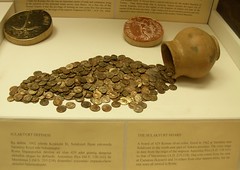
A 3rd century hoard of denarii in a small pot. This example is typical of the vessels used to protect buried hoards around the Mediterranean. The closing date (235) stands at around the transition from denarii to antoniniani. I might have hid my money, too.
Don't be misled by this post. The strength of the museum is its material from sites such as Catalhöyük, Alacahöyük, Boğazköy, Carchemish and elsewhere. Again, go if you can or enjoy the images on flickr.
I am in Ankara after attending Kültürel Mirası Koruma’da Yeni Yöntem ve Uygulamalar Sempozyumu/Symposium of The Preservation of Cultural Heritage: New Methods and Applications. The talks were all interesting and I'm grateful to my Turkish hosts for their hard work in putting the meeting together.
Today a group went to Gordion and to the Museum of Anatolian Civilizations (Wikipedia). This was my first visit to both so it was a great coda to an all-round wonderful trip.
The most impressive monument at Gordion is the so-called "Midas Tomb" (Tumulus MM), visible from the main highway as one drives to and from the site. Midas died c. 695 BC and Peter Kuniholm's dendrochronological investigations have put the cutting-date of the trees in the burial chamber some fifty years earlier. Hence the "so-called". Regardless of date, it's a must see site if you ever get the chance.
The museum is excellent and recently re-installed. The gallery past the opening one holds a series of cases that are generous in their use of pottery to illustrate trends in the history of the city. Flickr has a few illustrative images:
Middle Phrygian Dinos with creatures peeking over the rim.
Middle Phrygian Architectural Terracottas
Attic Import
A further note on absolute chronology: As discussed by Mary Voigt (p. 195), the destruction level that had been associated with the Kimmerian invasion and death of Midas has been pushed back to 830-800. There is some discrepancy between this chronology and some of the signage and labeling at the site and museum. But if one keeps this recent work in mind, it is interesting to ponder its implications for understanding the site.
The Museum of Anatolian Civilizations is superb, both in the quality of its collection and in the care with which it is displayed. Again, the installation is recent. It seems to be a popular spot since I quickly found many images on flickr. Try "museum anatolian civilizations". Explore for yourself but here is just a tiny sampling of what I enjoyed:
Hittite Ceramic Bulls. They are about waist high.
A 1st-2nd century AD tomb containing ceramics. This is a great image and you may want to download the full-size version. And here's a detail.
A 3rd century hoard of denarii in a small pot. This example is typical of the vessels used to protect buried hoards around the Mediterranean. The closing date (235) stands at around the transition from denarii to antoniniani. I might have hid my money, too.
Don't be misled by this post. The strength of the museum is its material from sites such as Catalhöyük, Alacahöyük, Boğazköy, Carchemish and elsewhere. Again, go if you can or enjoy the images on flickr.
Wednesday, March 5, 2008
Research Note: Dining and Numismatic Imagery during the Roman Empire (Version 1)
This post is offered as in-process research note. Nothing about it is complete, neither the evidence it collects, nor the citations to secondary scholarship that it makes, nor the conclusions that it reaches. It is also an unfinished translation of existing text and scanned images from desktop editing tools into a blog post. The planned venue for publication of the finished version is volume 1.2 of the new journal Past Discussed Quarterly (PDQ). I am making this very early draft available now so as to encourage "community review" prior to submission and, I hope, eventual acceptance. I therefore welcome comments and look forward to incorporating those into later versions of this note.
[A note on process: Some of the editing of the first version of this text happened directly within the Blogger interface. I'm sure this has introduced various typos and other misfortunes. My plan is to hit the "Publish" button and then copy-edit in-place. When I make major changes to content, I will publish those as a whole new post. This is all an experiment so bear with me.]
The following paragraphs provide a preliminary survey of the use of numismatic imagery in the decoration of objects related to dining during the Roman empire. Such use includes the actual incorporation of coins into the material culture of dining and also the copying of numismatic imagery into different media. In form, this note is essentially a list of objects that are examples of such incorporation and reuse.
Dining is defined very broadly and the objects listed below may well have been used in religious activities as opposed to daily meals. There is no need, however, to draw a very strong line between religion and daily life so that the objects collected below do all bear upon the issue of dining when the group is taken as whole. The importance of empire extends beyond merely the definition of the chronological bounds of the study, which at the current time focusses on the second and third centuries. Roman imperial coins, as well as most provincial issues, usually bore images of the current emperor and/or his family so that they are inherently "imperial" objects. Coins also have reverses whose legends and imagery can be understood to communicate themes of imperial propaganda, though the efficacy of this communication is a hotly debated topic in the field of ancient numismatics. Accordingly, when possible the list below will make clear which image, imperial portrait or reverse message, is displayed or reproduced. Doing so can make a small contribution to the problem of the extent to which numismatic imagery was actively examined and responded to by ancient viewers. Preliminary conclusions along these lines are made during the course of presenting the relevant objects.
Italian and Gaulish Sigillata Vessels
An article by Marabini Moevs (AJA 84 [1980]:322) makes reference in its text and notes to Italian and Gaulish Sigillata vessels whose decoration includes direct copies of coins. These are made by pressing the face of a coin into the molds in which such vessels were produced.
Partial list:
Even in the absence of a complete list of published pieces, it should be stressed that the direct reproduction of numismatic imagery on sigillata vessels is a sporadic phenomenon. Nonetheless, when such reproduction does occur it certainly illustrates an avenue for the incorporation of the imperial image into the visual setting of the meals at which such vessels were used.
Appliqué Medallion's on Claire-B Vessels from the southern Rhone valley
Claire-B is the name given to a well-slipped tableware manufactured in the Rhone valley around Lyon and further south. Table jugs with appliqué medallions are a regular part of this series and were meant for pouring wine and other beverages. Though they are larger than coins, the circular shape of these medallions means that they share some of the formal constraints and appearance of numismatic imagery. The following example drawn from Déchelette's 1904 survey of decorated vases from Gaul has obvious similarities with both coin and medallion reverses also showing scenes of imperial interaction with an assembled populace.

A medallion celebrating the defeat of Armenia shows a personification similar to those appearing on Antonine coinage:


It is probably not useful to say that either the ceramic or numismatic version of this image is the "original" that influenced the copy. Rather, they are both small-scale versions of visual motifs that appeared in larger media. To put this another way, provincial reproduction of imperial propaganda does not prove that numismatic reverses were the route by which such propaganda reached the provinces. It does suggest that coins existed in a milieu of images and that the numismatic versions may not have been ignored. Indeed, motifs that appear on coins were actually brought into people's homes in the form of ceramic vessels. This domestic acceptance of imperial imagery is a reminder of Greg Woolf's observation that the material correlates of "Romanization" are often the work of provincial craft industries. The combination of coin and vessel indicates that there was frequent interaction between imperial and provincial agency during the reception of images.
A bronze vessel now in Boston (mfa.org:63.2644)
In 1963, the Museum of Fine Arts in Boston acquired a bronze vessel from the well-known numismatic collector H. von Aulock, with the purchase being made in Istanbul and the object being understood to have come from western Asia Minor. In form it is a deep pot with rounded-walls and a flat handle extending from the rim. In these aspects it is unremarkable. More distinctive are the five coins attached to the exterior surface, with all showing their reverse side. As listed on the MFA's website, the coins are:
[These coins are sufficiently well-known and distinct so that the chronology can be inferred.]
In addition to these pieces, two coins were purchased later but are believed to have been attached to the vessel as well:
Assuming that the two detached coins are part of the original ensemble and also had their reverses visible, this collected group of images contains an eclectic mix of local gods and sacred animals, along side a hint of Roman sympathy/loyalty in the form of a reference to Aeneas and to the image of the emperor accompanied by Roma and a loyal province. In this provincial context, it is the reverse images that are chosen to achieve the transformation of this vessel from functional object into a bearer of meaning.
The Rennes Patera

Now in the collection of the Bibliothèque Nationale de France, the Rennes Patera was discovered in that French city in 1774 along with 43 aureii, the latest of which was issued during the reign of Aurelian (d. 275). The object is a shallow, gold plate, 1.315 kilos in weight - or aproximately 4 Roman pounds - with a central medallion showing a drunken Hercules standing next to a seated Bacchus, the two being engaged in a contest that pits strength against wine. The latter prevails, as shown by the surrounding motif of Bacchus' triumphal march, in which the victor rides in panther-drawn chariot, with the loser languishing bareback a few ranks behind him. While there is perhaps some humor to be found in this arrangement of images - though this much gold makes the joke expensive - there is also an explicit imperial context. The outermost band of decoration consists of 16 aureii depicting emperors ranging from Hadrian to Septimius Severus, alternated with junior and female members of the imperial families, including Severus' sons Caracalla and Geta as Caesars. In all cases the obverse is showing, though descriptions of both sides of each coin can be given following their removal and resetting, notes on which were published in 1858. The list of coins (Obverse/Reverse), starting from the top as indicated by the orientation of the central medallion and moving clock-wise, is:
Although the accompanying hoard dates the deposition of this object to the reign of Aurelian or later, it is presumably Severan in composition. The combination of this date with the objects Bacchic/Dionysiac, Herculean and Imperial associations makes several categories of evidence useful as context for understanding this object. The first category is epigraphic and relies on the overlap between Severus' manufactured ancestry as implied by the patera and as advertised in public inscriptions. Taking just one example, CIL VIII.9317, from Caesaria in Mauretania, begins with the following dedication:
Further Severan links are found in the Bacchic and Herculean imagery. Both gods are depicted on the reverse of a coin of Severus issued in 194 (RIC IV.25).
The coin is an official issue and the architectural sculpture is part of an imperially sponsored program of public display. Both Bacchus and Hercules were popular gods at this time as well (ANRW II.17.2:684-702; LIMC V:158) so that the motif of their contest also appears in private domestic contexts. It is found in the second-century mosaic decoration of the so-called Atrium House at Antioch (Illustrated at Ling 1998: fig. 33) and in an early third-century version from nearby Seleucia (Ling 1998:fig. 36).
These comparanda, not all of which would have been known to any single ancient viewer, reveal the Rennes Patera to be an extremely sophisticated object. It brings together a set of ideas that were current at the highest levels of both society and government. It belongs in this study because numismatic imagery is an essential component of the "program" of its visual composition, which highlights the role of coins in providing imperial portraits that could be re-used in non-commercial contexts. Of course, one cannot say that the patera was used during dining. It is plausibly a ritual object - perhaps a part of the imperial cult - and almost certainly used during extra-ordinary circumstances, and not during the repetitive occurrence of everyday meals. Nonetheless, authors such as Athenaeus create a place for Bacchus, Hercules and the Emperor at the Roman meal so that the Rennes Patera may give a window into the thoughts of drunk and loyal Roman aristocrats as they conversed merrily with each other during evening gatherings.
A final note is necessary when discussing this object. There are rumors that the patera is an 18th century fake; but without having found such an opinion in writing, I find this unlikely.
Jewelry
It was noted above that the Rennes Patera need not have been used in the setting of a meal. The same can be said of jewelry which incorporates coins. Bruhn's study of coins and costume is an excellent introduction to the topic (8-16,30-32). Her fig. 6, showing a necklace (metmuseum.org:36.9.1) with aurei of Lucius Verus, Julia Domna and Alexander Severus in pendant settings, is a good example of the prevalence of such pieces in the third century. Bruhn (32) also cites a 2nd century Egyptian funerary portrait, now in Detroit (dia.org:25.2). Zooming in on the deceased's necklace shows that the pendant holds a coin. It may also be reasonable to suggest that the obverse is showing.
A Late Antique Coda
The focus of this note is the pagan empire. A late Roman silver plate in Munich in which the central medallion copies a quinquennalia issue of Licinius II is relevant (cf. Leader-Newby 2004:20). A later example of a similar phenomenon is a silver plate, now last, incorporating a gold solidus of Theodosius II.

(After Barrate 1993:fig. 20)
Finally, I note an ARS lamp type (cf. Hayes 1980:313) which has the alternated impressions of the obverse and reverse of a gold coin (tremisses?) of Theodosius II impressed on its shoulder.

(After le Blant 1886:plate ii, for additional examples see Bejaui 1997:283)
At a time when the emperor stressed the religious unity of the state, it is fitting that these lamps' manufacturer would choose to show both the obverse and reverse of an imperial coin.
Appendix on Primary Texts
[Needs more passages and to be integrated into main text]
With the objects described above in mind, it is appropriate to consider some of the textual evidence for Roman attitudes towards coins. Suetonius relates that Augustus gave foreign coins as gifts during the Saturnalia.(Aug. 73) Philostratus in his early third century life of Apollonius of Tyana relates a story set during the reign of Tiberius, in which a slave-owner was convicted of impiety because the slave he struck was carrying a coin with the image of the emperor on it. Cassius Dio, also writing in the early third century, refers to coinage on numerous occasions. He relates that "...Brutus stamped upon the coins which were being minted his own likeness and a cap and two daggers, indicating by this and by the inscription that he and Cassius had liberated the fatherland." (LXVII.25) He also writes of a young equestrian was sentenced to death for taking a coin into a brothel and that a senator was similarly punished for wearing a coin of Augustus set in a necklace when he went to the toilet. Finally, he relates that under Elagabalus a certain “Valerianus Paetus was executed because he had because he had stamped some likenesses of himself and plated them with gold to serve as ornaments for his mistresses.”(LXXIX.4) This was seen as a precursor to rebellion. Although hardly unanimous, these and similar passages tend to confirm that it was the imperial likeness on coins that often drew the particular attention.
[A note on process: Some of the editing of the first version of this text happened directly within the Blogger interface. I'm sure this has introduced various typos and other misfortunes. My plan is to hit the "Publish" button and then copy-edit in-place. When I make major changes to content, I will publish those as a whole new post. This is all an experiment so bear with me.]
The following paragraphs provide a preliminary survey of the use of numismatic imagery in the decoration of objects related to dining during the Roman empire. Such use includes the actual incorporation of coins into the material culture of dining and also the copying of numismatic imagery into different media. In form, this note is essentially a list of objects that are examples of such incorporation and reuse.
Dining is defined very broadly and the objects listed below may well have been used in religious activities as opposed to daily meals. There is no need, however, to draw a very strong line between religion and daily life so that the objects collected below do all bear upon the issue of dining when the group is taken as whole. The importance of empire extends beyond merely the definition of the chronological bounds of the study, which at the current time focusses on the second and third centuries. Roman imperial coins, as well as most provincial issues, usually bore images of the current emperor and/or his family so that they are inherently "imperial" objects. Coins also have reverses whose legends and imagery can be understood to communicate themes of imperial propaganda, though the efficacy of this communication is a hotly debated topic in the field of ancient numismatics. Accordingly, when possible the list below will make clear which image, imperial portrait or reverse message, is displayed or reproduced. Doing so can make a small contribution to the problem of the extent to which numismatic imagery was actively examined and responded to by ancient viewers. Preliminary conclusions along these lines are made during the course of presenting the relevant objects.
Italian and Gaulish Sigillata Vessels
An article by Marabini Moevs (AJA 84 [1980]:322) makes reference in its text and notes to Italian and Gaulish Sigillata vessels whose decoration includes direct copies of coins. These are made by pressing the face of a coin into the molds in which such vessels were produced.
Partial list:
- An Arretine Krater with impressed coin of Augustus repeated 8 times. The legend "AVGVSTVS CAESAR" is legible. (ArchCl 7 [1955]).
- Impressions of a coin of a "Julio-Claudian prince" appear on a Southern Gallic bowl.(Knorr 1919:87)
- A single sherd of a late Italian Sigillata bowl partially preserves an obverse portrait of the empress Sabina (Marabini Moeves 1984)
- Arretine or Gallic bowl with impression of a coin with eagle. (ArchCl 7 [1955])
Even in the absence of a complete list of published pieces, it should be stressed that the direct reproduction of numismatic imagery on sigillata vessels is a sporadic phenomenon. Nonetheless, when such reproduction does occur it certainly illustrates an avenue for the incorporation of the imperial image into the visual setting of the meals at which such vessels were used.
Appliqué Medallion's on Claire-B Vessels from the southern Rhone valley
Claire-B is the name given to a well-slipped tableware manufactured in the Rhone valley around Lyon and further south. Table jugs with appliqué medallions are a regular part of this series and were meant for pouring wine and other beverages. Though they are larger than coins, the circular shape of these medallions means that they share some of the formal constraints and appearance of numismatic imagery. The following example drawn from Déchelette's 1904 survey of decorated vases from Gaul has obvious similarities with both coin and medallion reverses also showing scenes of imperial interaction with an assembled populace.

A medallion celebrating the defeat of Armenia shows a personification similar to those appearing on Antonine coinage:

It is probably not useful to say that either the ceramic or numismatic version of this image is the "original" that influenced the copy. Rather, they are both small-scale versions of visual motifs that appeared in larger media. To put this another way, provincial reproduction of imperial propaganda does not prove that numismatic reverses were the route by which such propaganda reached the provinces. It does suggest that coins existed in a milieu of images and that the numismatic versions may not have been ignored. Indeed, motifs that appear on coins were actually brought into people's homes in the form of ceramic vessels. This domestic acceptance of imperial imagery is a reminder of Greg Woolf's observation that the material correlates of "Romanization" are often the work of provincial craft industries. The combination of coin and vessel indicates that there was frequent interaction between imperial and provincial agency during the reception of images.
A bronze vessel now in Boston (mfa.org:63.2644)
In 1963, the Museum of Fine Arts in Boston acquired a bronze vessel from the well-known numismatic collector H. von Aulock, with the purchase being made in Istanbul and the object being understood to have come from western Asia Minor. In form it is a deep pot with rounded-walls and a flat handle extending from the rim. In these aspects it is unremarkable. More distinctive are the five coins attached to the exterior surface, with all showing their reverse side. As listed on the MFA's website, the coins are:
- Cyzicus. Dionysos seated on pantheress, holding thyrsos. (Commodus)
- Hierocaesarea. Artemis with a quiver or bowcase on shoulder facing Apollo (?) with lyre and cloak. (Commodus)
- Hierocaesarea. Artemis standing to right discharging arrow. Stag running at left, beside her. (Marcus Aurelius)
- Smyrna. Bull standing right. (Antinous)
- Smyrna. Bull standing right. (Antinous)
[These coins are sufficiently well-known and distinct so that the chronology can be inferred.]
In addition to these pieces, two coins were purchased later but are believed to have been attached to the vessel as well:
- Troy. Marcus Aurelius/Aeneas right bearing on left arm Anchises and looking left at Ascanius
- Koinon of Bithynia. Hadrian/Distyle temple with star in pediment; Hadrian stands between Bithynia and Roma, who crowns him.
Assuming that the two detached coins are part of the original ensemble and also had their reverses visible, this collected group of images contains an eclectic mix of local gods and sacred animals, along side a hint of Roman sympathy/loyalty in the form of a reference to Aeneas and to the image of the emperor accompanied by Roma and a loyal province. In this provincial context, it is the reverse images that are chosen to achieve the transformation of this vessel from functional object into a bearer of meaning.
The Rennes Patera
Now in the collection of the Bibliothèque Nationale de France, the Rennes Patera was discovered in that French city in 1774 along with 43 aureii, the latest of which was issued during the reign of Aurelian (d. 275). The object is a shallow, gold plate, 1.315 kilos in weight - or aproximately 4 Roman pounds - with a central medallion showing a drunken Hercules standing next to a seated Bacchus, the two being engaged in a contest that pits strength against wine. The latter prevails, as shown by the surrounding motif of Bacchus' triumphal march, in which the victor rides in panther-drawn chariot, with the loser languishing bareback a few ranks behind him. While there is perhaps some humor to be found in this arrangement of images - though this much gold makes the joke expensive - there is also an explicit imperial context. The outermost band of decoration consists of 16 aureii depicting emperors ranging from Hadrian to Septimius Severus, alternated with junior and female members of the imperial families, including Severus' sons Caracalla and Geta as Caesars. In all cases the obverse is showing, though descriptions of both sides of each coin can be given following their removal and resetting, notes on which were published in 1858. The list of coins (Obverse/Reverse), starting from the top as indicated by the orientation of the central medallion and moving clock-wise, is:
- Hadrian/Hispania Reclining/HISPANIA
- Caracalla/Geta r.
- Marcus Aurelius/Victory advancing
- Faustina, Jr./Laetitia stg.,LAETITIA
- Antoninus Pius/Liberalitas stg.
- Geta/Severus btw. std. sons.
- Commodus/Liberty, LIBERT
- Diva Faustina/Ceres stg.
- Septimius Severus/Caracalla and Geta,AETERNIT IMPERI
- Caracalla/Severus and Julia Domna, CONCORDIAE AETERNAE
- Antoninus Pius/Jupiter std.
- Diva Faustina/Ceres
- Antoninus Pius/Liberalitas stg.
- Commodus/Hilaritas, HILARITAS
- Septimius Severus/Julia Domna btw. Caracalla and Geta
- Julia Domna/Laetitia stg., LAETITIA
Although the accompanying hoard dates the deposition of this object to the reign of Aurelian or later, it is presumably Severan in composition. The combination of this date with the objects Bacchic/Dionysiac, Herculean and Imperial associations makes several categories of evidence useful as context for understanding this object. The first category is epigraphic and relies on the overlap between Severus' manufactured ancestry as implied by the patera and as advertised in public inscriptions. Taking just one example, CIL VIII.9317, from Caesaria in Mauretania, begins with the following dedication:
To Imperator Caesar, son of the divine Marcus Antoninus Pius Sarmaticus Germanicus, brother of the divine Commodus, grandson of the divine Antoninus Pius, great-grandson of the divine Hadrian, descendant of the divine Trajan Parthicus, descendant of the divine Nerva, Lucius Septimius Severus Pius Pertinax Augustus…While the patera does not stretch back so far as Nerva, the emperors Hadrian, Antoninus Pius, Marcus Aurelius and Commodus do appear. This suggests considerable awareness of, and sensitivity to, Severan dynastic concerns on the part of the designer/patron of this object. That Pertinax is not represented among the depicted emperors is not a surprise given Septimius' emphasis of his manufactured Antonine descent. [On a practical note, the gold of Pertinax may not have so readily available.] The alternated family portraits, culminating to some extent in the then current heirs Caracalla and Geta, only add to the dynastic context.
Further Severan links are found in the Bacchic and Herculean imagery. Both gods are depicted on the reverse of a coin of Severus issued in 194 (RIC IV.25).
The pairing of Bacchus and Hercules is also found in the Basilica at Severus' hometown of Leptis Magna. Here the pilasters to the left and right of the apse are decorated with scenes from the lives of each divinity. (flicker, flickr [both with cc licenses]).Courtesy of CNG Coins, via Wildwinds
The coin is an official issue and the architectural sculpture is part of an imperially sponsored program of public display. Both Bacchus and Hercules were popular gods at this time as well (ANRW II.17.2:684-702; LIMC V:158) so that the motif of their contest also appears in private domestic contexts. It is found in the second-century mosaic decoration of the so-called Atrium House at Antioch (Illustrated at Ling 1998: fig. 33) and in an early third-century version from nearby Seleucia (Ling 1998:fig. 36).
These comparanda, not all of which would have been known to any single ancient viewer, reveal the Rennes Patera to be an extremely sophisticated object. It brings together a set of ideas that were current at the highest levels of both society and government. It belongs in this study because numismatic imagery is an essential component of the "program" of its visual composition, which highlights the role of coins in providing imperial portraits that could be re-used in non-commercial contexts. Of course, one cannot say that the patera was used during dining. It is plausibly a ritual object - perhaps a part of the imperial cult - and almost certainly used during extra-ordinary circumstances, and not during the repetitive occurrence of everyday meals. Nonetheless, authors such as Athenaeus create a place for Bacchus, Hercules and the Emperor at the Roman meal so that the Rennes Patera may give a window into the thoughts of drunk and loyal Roman aristocrats as they conversed merrily with each other during evening gatherings.
A final note is necessary when discussing this object. There are rumors that the patera is an 18th century fake; but without having found such an opinion in writing, I find this unlikely.
Jewelry
It was noted above that the Rennes Patera need not have been used in the setting of a meal. The same can be said of jewelry which incorporates coins. Bruhn's study of coins and costume is an excellent introduction to the topic (8-16,30-32). Her fig. 6, showing a necklace (metmuseum.org:36.9.1) with aurei of Lucius Verus, Julia Domna and Alexander Severus in pendant settings, is a good example of the prevalence of such pieces in the third century. Bruhn (32) also cites a 2nd century Egyptian funerary portrait, now in Detroit (dia.org:25.2). Zooming in on the deceased's necklace shows that the pendant holds a coin. It may also be reasonable to suggest that the obverse is showing.
A Late Antique Coda
The focus of this note is the pagan empire. A late Roman silver plate in Munich in which the central medallion copies a quinquennalia issue of Licinius II is relevant (cf. Leader-Newby 2004:20). A later example of a similar phenomenon is a silver plate, now last, incorporating a gold solidus of Theodosius II.

(After Barrate 1993:fig. 20)
Finally, I note an ARS lamp type (cf. Hayes 1980:313) which has the alternated impressions of the obverse and reverse of a gold coin (tremisses?) of Theodosius II impressed on its shoulder.

(After le Blant 1886:plate ii, for additional examples see Bejaui 1997:283)
At a time when the emperor stressed the religious unity of the state, it is fitting that these lamps' manufacturer would choose to show both the obverse and reverse of an imperial coin.
Appendix on Primary Texts
[Needs more passages and to be integrated into main text]
With the objects described above in mind, it is appropriate to consider some of the textual evidence for Roman attitudes towards coins. Suetonius relates that Augustus gave foreign coins as gifts during the Saturnalia.(Aug. 73) Philostratus in his early third century life of Apollonius of Tyana relates a story set during the reign of Tiberius, in which a slave-owner was convicted of impiety because the slave he struck was carrying a coin with the image of the emperor on it. Cassius Dio, also writing in the early third century, refers to coinage on numerous occasions. He relates that "...Brutus stamped upon the coins which were being minted his own likeness and a cap and two daggers, indicating by this and by the inscription that he and Cassius had liberated the fatherland." (LXVII.25) He also writes of a young equestrian was sentenced to death for taking a coin into a brothel and that a senator was similarly punished for wearing a coin of Augustus set in a necklace when he went to the toilet. Finally, he relates that under Elagabalus a certain “Valerianus Paetus was executed because he had because he had stamped some likenesses of himself and plated them with gold to serve as ornaments for his mistresses.”(LXXIX.4) This was seen as a precursor to rebellion. Although hardly unanimous, these and similar passages tend to confirm that it was the imperial likeness on coins that often drew the particular attention.
Friday, February 29, 2008
Various Items
- The Antikythera Survey Project (ASP) has a nice website. The results page has links to brief overviews of Prehistoric , Classical-Roman, and Medieval-Recent Pottery. These pages are available in Greek as well. The Downloads page provides access to a selection of field-data and imagery.
- On a related note, the ASP page on Classical-Roman Pottery links to a PDF of Acta Terrae Septemcastrensis V.1 (2006). Speaking of 'rare publications', Worldcat lists one institution that subscribes to this series, though there may be cataloging issues hiding other holdings. But this one volume can't be rare if it's online, right? Download it for the many contributions that include ceramic evidence. For example, the ASP article on page 223 by Nikoleta Pyrrou illustrates a stamped Phokaian Red-Slip (LRC) sherd and some hard to make out Late Roman Amphora 2.
- I've poked about Search Pigeon, a Google Custom Search tool for open-access journals. Searching for 'roman pottery' led me to Hrčak: Portal of scientific journals of Croatia, on which I found Kristina Jelinčić's Roman Pottery from Ilok, and to Marwan Abu Khalaf, Ibrahim Abu A‘mar, Salah Al-Houdalieh, and Robert Hoyland's The Byzantine and Early Islamic settlement of Khirbat Shuwayka. The latter has nice color images of late roman pottery.
- The UPenn library now lists Babesch - Bulletin Antieke Beschaving in its digital holdings. Among other titles, I downloaded D. Malfitana, J. Poblome and J. Lund, Eastern Sigillata A in Italy: a socio-economic evaluation, vol. 80 (2005) and D. Steures' Late Roman Thirst: how dark coloured drinking sets from Trier were used, vol. 77 (2002). I am glad to now have both in my collection of digital offprints.
Wednesday, February 27, 2008
Fathi Bejaoui, Ceramique et Religion Chretienne
Current Epigraphy runs a series of posts on rare publications. Here's one in ceramics:
Bejaoui, F. (1997) Céramique et Religion Chrétienne: les thèmes bibliques sur la sigillée africaine, Tunis. (worldcat)
According to Worldcat, it is held by five American and two European institutions.
By way of reaction, the sometimes poor black-and-white images don't detract from this being a useful collection of interesting iconography.
Bejaoui, F. (1997) Céramique et Religion Chrétienne: les thèmes bibliques sur la sigillée africaine, Tunis. (worldcat)
According to Worldcat, it is held by five American and two European institutions.
By way of reaction, the sometimes poor black-and-white images don't detract from this being a useful collection of interesting iconography.
Various Items
- The list of watchable video episodes at Emerging Cypriot, from the Pyla-Koutsopetria Archaeological Project, continues to grow. The second and third shorts have a lot of ceramic content and are well-worth downloading. The whole idea is great but I have a critique of the presentation. When you go to the site, the titles of the not yet released episodes are shown but you have to mouse-over thumbnail images representing the available ones to see what you're going to get. This is odd and may prioritize the visual effect triggered by the mouse-over rather than the experience of a user trying to find a particular episode. When they are all released, it will be hard to find any one title.
- The PDF of F. de Callataÿ and H. Gitler's The Coin of Coins illustrates a nice overlap between ceramic and numismatic imagery on page 38.
- Gabriel Bijovsky's article A Byzantine Gold Hoard from Bet She'an from the American Numismatic Society Magazine has images of sixth to seventh century ceramics as well. The full publication of the hoard is in Revue Numismatique 158 (2002).
Thursday, February 21, 2008
PRAP and Geography Markup Language (GML)
I have begun moving PRAP's GIS data from ESRI shapefiles into Geography Markup Language (GML) and have included the resulting files in the pre-release version of the PRAP Digital Archive.
The initial conversion was easy. I used the macports.org site to install the GDAL libraries, which include tools for working with vector data. Converting the shapefile that represents the tracts PRAP walked required only executing the command 'ogr2ogr -f "GML" tracts.gml tracts.shp'. This produced an xml file in gml format that required just a little cleaning to be on its way to something that I'll be comfortable archiving. Here's an example of how the outlines of a tract are currently represented in that file:
Sure, GML is verbose but that's not a problem since I'm delivering the archive as a compressed tar ball. An actual problem is that the PRAP data is not currently georeferenced so that the co-ords you see above represent an arbitrary grid the project established for its study area. Converting this grid to UTM is doable and is "on my list".
After a few more conversions, the files "tracts.gml", "coast.gml", and "surveyed.gml" can be found in the "spatial/gml" directory of the archive. I have displayed all of these in the open source mapping application QGis so that I know they're passable GML, if not fully compliant with the latest version of the standard.
I have also added an examples directory. The only files in there now are "mapars.xsl" and "ars.gml". "mapars.xsl" is a style sheet that will query the pottery records in the file 'compiled/prap_gml.xml' to find the African Red-Slip, extract the tracts in which those sherds were found, and write that list to a gml file that can likewise be displayed in QGis or any other GML-aware mapping program. Here's the stylesheet:
"ars.gml" is the mappable gml file; see the comment at the top of the stylesheet for the command that will generate it once you've unpacked the tar ball.
To be clear, I think this is incredibly cool. PRAP is now moving towards a consistent xml-based representation for all its data other than digitized photographs. I've already written about using svg to represent ceramic profiles. I will apply the same technique to PRAP's drawings. This consistency of representation will allow PRAP to use the same set of open-source tools to manipulate, analyze, report on and publish its results. And not only will we be able to publish the base data and the results, we will be equally clear about the processes that were applied to the data in order to reach our interpretations.
Data, algorithms and results will all be there for everyone to see. Or at least, that's the idea. There's a long way to go before it happens.
The initial conversion was easy. I used the macports.org site to install the GDAL libraries, which include tools for working with vector data. Converting the shapefile that represents the tracts PRAP walked required only executing the command 'ogr2ogr -f "GML" tracts.gml tracts.shp'. This produced an xml file in gml format that required just a little cleaning to be on its way to something that I'll be comfortable archiving. Here's an example of how the outlines of a tract are currently represented in that file:
<gml:featureMember gml:id="prap:collectionunit:K94-001">
  <gml:geometryProperty>
    <gml:Polygon>
      <gml:outerBoundaryIs>
        <gml:LinearRing>
          <gml:coordinates>15200.344657999999981,28729.004949499998474 15213.297062499999811,28831.356068500001129 15221.920192999999927,28827.91327050000109 15228.021194499999183,28823.439226499998767 15222.873737500000061,28762.960040000001754 15268.410846500000844,28761.380233500000031 15266.11084800000026,28728.121744000000035 15200.344657999999981,28729.004949499998474</gml:coordinates>
        </gml:LinearRing>
      </gml:outerBoundaryIs>
    </gml:Polygon>
  </gml:geometryProperty>
</gml:featureMember>
Sure, GML is verbose but that's not a problem since I'm delivering the archive as a compressed tar ball. An actual problem is that the PRAP data is not currently georeferenced so that the co-ords you see above represent an arbitrary grid the project established for its study area. Converting this grid to UTM is doable and is "on my list".
After a few more conversions, the files "tracts.gml", "coast.gml", and "surveyed.gml" can be found in the "spatial/gml" directory of the archive. I have displayed all of these in the open source mapping application QGis so that I know they're passable GML, if not fully compliant with the latest version of the standard.
I have also added an examples directory. The only files in there now are "mapars.xsl" and "ars.gml". "mapars.xsl" is a style sheet that will query the pottery records in the file 'compiled/prap_gml.xml' to find the African Red-Slip, extract the tracts in which those sherds were found, and write that list to a gml file that can likewise be displayed in QGis or any other GML-aware mapping program. Here's the stylesheet:
<?xml version="1.0" encoding="utf-8"?>
<!--
Running 'xsltproc mapars.xsl ../compiled/prap_gml.xml > ars.gml'
will produce a gml file showing tracts where African Red-Slip (ars) was
recorded.
-->
<xsl:stylesheet version="1.0" xmlns:xsl="http://www.w3.org/1999/XSL/Transform"
 xmlns:x="http://www.w3.org/2002/06/xhtml2/"
 xmlns:gml="http://www.opengis.net/gml"
 xmlns:exsl="http://exslt.org/common"
 extension-element-prefixes="exsl">
 <xsl:output method="xml" encoding="utf-8" indent="yes"/>

 <xsl:key name="classes" match="//*[@class]" use="@class"/>
 <xsl:key name="ware" match="//x:div[@class='pottery']" use="x:span[@property='ware']"/>
 <xsl:key name="gml:ids" match="//*[@gml:id]" use="@gml:id"/>

 <xsl:template match="/">
<gml:FeatureCollection xmlns:gml="http://www.opengis.net/gml">
  <gml:boundedBy>
    <gml:Box>
      <gml:coord>
        <gml:X>14625.166504</gml:X>
        <gml:Y>13709.92893965028</gml:Y>
      </gml:coord>
      <gml:coord>
        <gml:X>35518.298225</gml:X>
        <gml:Y>30227.18022459958</gml:Y>
      </gml:coord>
    </gml:Box>
  </gml:boundedBy>

  <xsl:for-each select="key('ware','African Red-Slip')">
    <xsl:variable name="cuid" select="concat('prap:collectionunit:',x:span[@property='cuidentifier'])"/>
    <xsl:copy-of select="key('gml:ids',$cuid)"/>
   </xsl:for-each>
</gml:FeatureCollection>
 </xsl:template>

</xsl:stylesheet>
"ars.gml" is the mappable gml file; see the comment at the top of the stylesheet for the command that will generate it once you've unpacked the tar ball.
To be clear, I think this is incredibly cool. PRAP is now moving towards a consistent xml-based representation for all its data other than digitized photographs. I've already written about using svg to represent ceramic profiles. I will apply the same technique to PRAP's drawings. This consistency of representation will allow PRAP to use the same set of open-source tools to manipulate, analyze, report on and publish its results. And not only will we be able to publish the base data and the results, we will be equally clear about the processes that were applied to the data in order to reach our interpretations.
Data, algorithms and results will all be there for everyone to see. Or at least, that's the idea. There's a long way to go before it happens.
Sunday, February 17, 2008
Mediterranean Ceramics Reference Stability Report, Number 5
The MCRSR first appeared in October, 2007. For the fifth installment, I am again making only one addition, no. 16, a Halaf period jar from Domuztepe in Turkey. The information for this piece comes from Open Context, a project that describes itself as:
The previously listed URLs for MCRSR items 1-15 remain valid. Readers of last month's report will note that this means that no. 4 from the American Journal of Archaeology is still available at ajaonline.org.
1. Walters' Catalogue of the Roman Pottery in the Departments of Antiquities, British Museum from Google Books: http://books.google.com/books?id=M2UEAAAAYAAJ
2. Robinson's Agora V from JSTOR: http://links.jstor.org/sici?sici=1558-8610%281959%295%3C%3E1.0.CO%3B2-3
3. Lattara 6: http://www.lattara.net/LATTARAPUB/PUBLAT/LATTARA6/lattara6.html
4. K. Greene's AJA article on Early Roman lead glazed pottery: http://www.ajaonline.org/pdfs/111.4/AJA1114_Greene.pdf
5. Heath and Tekkök, Greek, Roman and Byzantine Pottery at Ilion (Troia): http://classics.uc.edu/troy/grbpottery/
6. Vessel from Çatalhoyuk (via Flickr): http://www.flickr.com/photos/catalhoyuk/971964416/
7. A Late Minoan III Pyxis from the Metropolitan Museum of Art: http://www.metmuseum.org/toah/ho/03/eus/hod_1999.423.htm
8. An undocumented ARS Hayes 70 bowl from the dealer Classical Numismatics Group: http://cngcoins.com/Coin.aspx?CoinID=86618
9. Fifteenth Century Mosque Lamp from Jerusalem now in the British Museum: http://www.britishmuseum.org/explore/highlights/highlight_objects/me/m/mosque_lamp.aspx
10. The Perseus Project Vase Catalog: http://www.perseus.tufts.edu/cgi-bin/ptext?doc=Perseus%3Atext%3A1999.04.0043
11. Wikimedia Commons Image of a Greek Geometric Skyphos in the Louvre: http://commons.wikimedia.org/wiki/Image:Skyphos_birds_Louvre_CA3822.jpg
12. Sagalassos from Pleiades: http://pleiades.stoa.org/places/639087
13. Inscribed pot from Aphrodisias (HTML): http://insaph.kcl.ac.uk/iaph2007/iAph150353.html
14. Inscribed pot from Aphrodisias (XML): http://insaph.kcl.ac.uk/iaph2007/xml/iAph150353.xml
15. Hellenistic lamp from Assos, Turkey at the Museum of Fine Arts, Boston: http://mfa.org/collections/search_art.asp?recview=true&id=199476&coll_keywords=&coll_accession=84%2E110&coll_name=&coll_artist=&coll_place=&coll_medium=&coll_culture=&coll_classification=&coll_credit=&coll_provenance=&coll_location=&coll_has_images=&coll_on_view=&coll_sort=2&coll_sort_order=0&coll_view=0&coll_package=0&coll_start=1
16. Open Context record for Halaf period jar from Domuztepe, Turkey: http://www.opencontext.org/database/space.php?item=14926_DT_Spatial
a free, open access resource for the electronic publication of primary field research from archaeology and related disciplines.It is useful that there is a concise url established for each record in Open Context. On the page linked below, you'll see a "Cite Item" button that provides a full citation for this piece. It seems, however, that all such Open Context URLs include the string "space.php?". A brief exchange with Eric Kansa, Open Context's lead developer, has indicated that these unnecessary characters may be removed in the future.
The previously listed URLs for MCRSR items 1-15 remain valid. Readers of last month's report will note that this means that no. 4 from the American Journal of Archaeology is still available at ajaonline.org.
1. Walters' Catalogue of the Roman Pottery in the Departments of Antiquities, British Museum from Google Books: http://books.google.com/books?id=M2UEAAAAYAAJ
2. Robinson's Agora V from JSTOR: http://links.jstor.org/sici?sici=1558-8610%281959%295%3C%3E1.0.CO%3B2-3
3. Lattara 6: http://www.lattara.net/LATTARAPUB/PUBLAT/LATTARA6/lattara6.html
4. K. Greene's AJA article on Early Roman lead glazed pottery: http://www.ajaonline.org/pdfs/111.4/AJA1114_Greene.pdf
5. Heath and Tekkök, Greek, Roman and Byzantine Pottery at Ilion (Troia): http://classics.uc.edu/troy/grbpottery/
6. Vessel from Çatalhoyuk (via Flickr): http://www.flickr.com/photos/catalhoyuk/971964416/
7. A Late Minoan III Pyxis from the Metropolitan Museum of Art: http://www.metmuseum.org/toah/ho/03/eus/hod_1999.423.htm
8. An undocumented ARS Hayes 70 bowl from the dealer Classical Numismatics Group: http://cngcoins.com/Coin.aspx?CoinID=86618
9. Fifteenth Century Mosque Lamp from Jerusalem now in the British Museum: http://www.britishmuseum.org/explore/highlights/highlight_objects/me/m/mosque_lamp.aspx
10. The Perseus Project Vase Catalog: http://www.perseus.tufts.edu/cgi-bin/ptext?doc=Perseus%3Atext%3A1999.04.0043
11. Wikimedia Commons Image of a Greek Geometric Skyphos in the Louvre: http://commons.wikimedia.org/wiki/Image:Skyphos_birds_Louvre_CA3822.jpg
12. Sagalassos from Pleiades: http://pleiades.stoa.org/places/639087
13. Inscribed pot from Aphrodisias (HTML): http://insaph.kcl.ac.uk/iaph2007/iAph150353.html
14. Inscribed pot from Aphrodisias (XML): http://insaph.kcl.ac.uk/iaph2007/xml/iAph150353.xml
15. Hellenistic lamp from Assos, Turkey at the Museum of Fine Arts, Boston: http://mfa.org/collections/search_art.asp?recview=true&id=199476&coll_keywords=&coll_accession=84%2E110&coll_name=&coll_artist=&coll_place=&coll_medium=&coll_culture=&coll_classification=&coll_credit=&coll_provenance=&coll_location=&coll_has_images=&coll_on_view=&coll_sort=2&coll_sort_order=0&coll_view=0&coll_package=0&coll_start=1
16. Open Context record for Halaf period jar from Domuztepe, Turkey: http://www.opencontext.org/database/space.php?item=14926_DT_Spatial
Friday, February 8, 2008
Emerging Cypriot Update
As noted by Bill Caraher in a comment to my last post, "An Artifact's Journey" wasn't supposed to be released yet. As I said, it's a nice piece so I hope it comes back soon.
Thursday, February 7, 2008
Emerging Cypriot
The Pyla-Koutsopetria Archaeological Project has begun to release a collection of video shorts under the title Emerging Cypriot. So far they seem nicely done. It does look like there's a little confusion with the links in that the top-right thumbnail, "Learning Fieldwalking", links to the video "An Artifact's Journey". No bother since "Journey" follows the route of a sherd through processing and drawing. I enjoyed that.
One not quite substantive comment, the URL for the "Journey" short ends with "An%20Artifact's%20Journey.m4v". That means the file name has spaces and an apostrophe in it. This is wasn't a problem for me but I can imagine situations in which those characters will cause problems on a command line.
One not quite substantive comment, the URL for the "Journey" short ends with "An%20Artifact's%20Journey.m4v". That means the file name has spaces and an apostrophe in it. This is wasn't a problem for me but I can imagine situations in which those characters will cause problems on a command line.
PRAP Images: From Join Table to Containment
In my ongoing effort to create an archival version of PRAP's field data, I'm looking at how we dealt with image metadata and what we want to do now. A basic issue with the photographic record of an archaeological field project is that each photo can be of multiple subjects and each potential subject - a site, a tract, a piece of pottery - can appear in multiple photos. Photograph 203.29 is an example.
These relationships aren't very hard to handle in an adequate fashion with a modern database using a straigtforward many-to-many structure. At PRAP we had a table listing photographs and a separate table listing what identifiable entities appeared in each photograph. The latter can be called a join table. A schematic representation of the content of image 203.29 would be as follows:
Photographs
id: 203.29
filmtype: color slide
caption: byz sherds from area B.
Image<->Subject Join Table
photo_id: 203.29
subject_id: B92-181-02
position: left
photo_id:203.29
subject_id: B92-181-03
position: right
Sherds
id:B92-181-02
<info about sherd>
id:B92-181-03
<info about sherd>
I'm skipping over a whole lot of detail but I hope it's clear that this establishes that sherd B92-181-02 is the object at the left of photo 203.29. You can see this information put into action with further links on the PRAP website, which is serving the filemaker versions of our databases.
At this point I should say that it was Debi Harlan, now of the excellent ArchAtlas project, and I who implemented this system in the field.
One way to represent this many-to-many concept in xml is just to wrap markup around the records of the join table and leave it at that. For example:
You can see that each 'imagelink' div refers to a separately instantiated image and a separately instantiated subject. Unfortunately, there is some fragility and a lot of unnecessary overhead to this structure. The fragility comes from the possibility of change in one the joined tables. Perhaps "203.29" was a typo in the database. If you change the id of a photo, it needs to be changed in the join information as well.
XML allows one to take advantage of containment to incorporate the link information directly into the image database as follows:
I'm not yet happy with the details of this markup. Among the many odd things is the extra 'span' surrounding each subject-position pair. I'd like to call that something. The advantage of this representation is that the text from <div> to </div> is a self-contained description of the image with well-structured links to the named entities that appear within it.
One last point... I was not about to cut-and-paste the subject info into each image div. Instead, I wrote a quick-and-dirty xslt stylesheet to process the two xml datasets and produce a single set of image descriptions that point to their subjects. Here it is:
This stylesheet has now been used to combine the image and image link portions of the PRAP Digital Archive and the tar ball has been updated.
I realize that I'm diving right into xml, xslt, etc. without much explanation. One purpose of this post is simply to share notes on what I've done. The other is to move towards the idea of a "PRAP Digital Archive Cookbook" that illustrates how to work with the PRAP data. This post can't be the beginning of such a publication since it has described a process that changed the underlying files in such a way that the just quoted xslt stylesheet will no longer work. But stay tuned for more fun things to do with this developing dataset...
These relationships aren't very hard to handle in an adequate fashion with a modern database using a straigtforward many-to-many structure. At PRAP we had a table listing photographs and a separate table listing what identifiable entities appeared in each photograph. The latter can be called a join table. A schematic representation of the content of image 203.29 would be as follows:
Photographs
id: 203.29
filmtype: color slide
caption: byz sherds from area B.
Image<->Subject Join Table
photo_id: 203.29
subject_id: B92-181-02
position: left
photo_id:203.29
subject_id: B92-181-03
position: right
Sherds
id:B92-181-02
<info about sherd>
id:B92-181-03
<info about sherd>
I'm skipping over a whole lot of detail but I hope it's clear that this establishes that sherd B92-181-02 is the object at the left of photo 203.29. You can see this information put into action with further links on the PRAP website, which is serving the filemaker versions of our databases.
At this point I should say that it was Debi Harlan, now of the excellent ArchAtlas project, and I who implemented this system in the field.
One way to represent this many-to-many concept in xml is just to wrap markup around the records of the join table and leave it at that. For example:
Image<->Subject Join
<div class="imagelink">
  <span property="image" src="prap:image:203.29" />
  <span property="subject" src="prap:pottery:B92-181-02" />
  <span property="position">Left</span>
</div>
<div class="imagelink">
  <span property="image" src="prap:image:203.29" />
  <span property="subject" src="prap:pottery:B92-186-03" />
  <span property="position">Right</span>
</div>

Image Info
<div class="image" id="prap:image:203.29">
  <span  property="filmtype">CS</span>
  <span  property="label">Late Byzantine decorated base contiguous to Site B02, Kavalaria; Byzantine decorated bowl rim from B team tract</span>
  <span  property="photologdescription">B-92-181-2 (left), B-92-186-3 (right), respectively LByz decorated base, Byz decorated bowl rim</span>
</div>
You can see that each 'imagelink' div refers to a separately instantiated image and a separately instantiated subject. Unfortunately, there is some fragility and a lot of unnecessary overhead to this structure. The fragility comes from the possibility of change in one the joined tables. Perhaps "203.29" was a typo in the database. If you change the id of a photo, it needs to be changed in the join information as well.
XML allows one to take advantage of containment to incorporate the link information directly into the image database as follows:
<div class="image" id="prap:image:203.29">
  <span  property="filmtype">CS</span>
  <span  property="label">Late Byzantine decorated base contiguous to Site B02, Kavalaria; Byzantine decorated bowl rim from B team tract</span>
  <span  property="photologdescription">B-92-181-2 (left), B-92-186-3 (right), respectively LByz decorated base, Byz decorated bowl rim</span>
  <span property="subjects">
    <span>
      <span  property="subject" src="prap:pottery:B92-181-02" />
      <span  property="position">Left</span>
    </span>
    <span>
      <span  property="subject" src="prap:pottery:B92-186-03" />
      <span  property="position">Right</span>
    </span>
  </span>
</div>
I'm not yet happy with the details of this markup. Among the many odd things is the extra 'span' surrounding each subject-position pair. I'd like to call that something. The advantage of this representation is that the text from <div> to </div> is a self-contained description of the image with well-structured links to the named entities that appear within it.
One last point... I was not about to cut-and-paste the subject info into each image div. Instead, I wrote a quick-and-dirty xslt stylesheet to process the two xml datasets and produce a single set of image descriptions that point to their subjects. Here it is:
<?xml version="1.0" encoding="utf-8"?>
<xsl:stylesheet version="1.0"
xmlns:xsl="http://www.w3.org/1999/XSL/Transform"
xmlns:x="http://www.w3.org/2002/06/xhtml2/" >
<xsl:key name="classes" match="//*[@class]" use="@class"/>
<xsl:key name="srcs" match="//*[@src]" use="@src"/>
<xsl:template match="/">
<xsl:for-each select="key('classes','image')">
<div class="{@class}" id="{@id}">
<xsl:copy-of select="./*"/>
<span property="subjects">
<xsl:for-each select="key('srcs',@id)/..">
<span>
<xsl:choose>
<xsl:when test="count(x:span[@property='subject']) > 1">
<xsl:apply-templates select="x:span[not(@property='image')]"/>
</xsl:when>
<xsl:otherwise>
<xsl:copy-of select="x:span[not(@property='image')]"/>
</xsl:otherwise>
</xsl:choose>
</span>
</xsl:for-each>
</span>
</div>
</xsl:for-each>
</xsl:template>
<xsl:template match="x:span">
<xsl:if test="not(contains(@src,':collectionunit:'))">
<xsl:copy-of select="."/>
</xsl:if>
</xsl:template>
</xsl:stylesheet>
This stylesheet has now been used to combine the image and image link portions of the PRAP Digital Archive and the tar ball has been updated.
I realize that I'm diving right into xml, xslt, etc. without much explanation. One purpose of this post is simply to share notes on what I've done. The other is to move towards the idea of a "PRAP Digital Archive Cookbook" that illustrates how to work with the PRAP data. This post can't be the beginning of such a publication since it has described a process that changed the underlying files in such a way that the just quoted xslt stylesheet will no longer work. But stay tuned for more fun things to do with this developing dataset...
Friday, February 1, 2008
PRAP, xhtml 2.0 and Archaeological Databases
For some years now I have been working in collaboration with many colleagues on data from the Pylos Regional Archaeological Project (PRAP). As with most more-or-less recent field-projects, one result of all our work is a collection of database files. Ours happen to be in FileMaker but that's a detail in terms of this discussion. What I really want to focus on is our decision to package all the data into an archival format that can be made available for use by all-comers and for storage by institutions that want to help ensure access to this resource over the long term. But what format should we use?
There are a couple of options that are specific to archaeology and/or cultural heritage management. Open Context is using a subset of the ArchaeoML datamodel. There's also the CIDOC Conceptual Reference Model. Right now, I am moving the PRAP data into an xhtml 2.0 based representation and thought I'd take the time to say what I like about it. Of course, I don't mean to reject other options. It's just that I'm looking for a lightweight standard in which to test the data and relationships that we want to archive in as accessible a format as possible. Who knows what will come in the future so for now I'm focusing on the present.
PRAP is a survey project so the first phase of fieldwork was to collect material by tracts, defined roughly as units of similar surface conditions: an olive grove (perhaps divided), a terrace, a fallow field. On the basis of density, Places Of Special Interest (POSIs) were identified - I'll call them sites from now on. Sites where then collected by a grid or by subdividing tracts. Either way, the material from a site consisted of both the tract collection material and the site collection material. Both tracts and the divisions of the site pickup are generically known as "collection units". Collection units held pottery and collected sherds could be numbered by extending the collection unit from which they came. In this system, "A92-001" is a tract collection unit, "A93-901001" is a site collection unit, and "A92-001-01" is a sherd from the tract, whereas "A93-901001-01" is from the site collection.
I'll now go over some broad ideas for representing this data model in xhtml .
Version of 2.0 of xhtml includes the Core, Embedding, and Metainformation attribute modules. In combination with the div and span elements, these modules make the following hypothetical xml fragments/stubs (almost) valid as part of a more complete document.
First, two sherds:
<div class="pottery" id="prap:pottery:A92-001-01">
<span property="ware">African Red Slip</span>
<span property="part">Rim</part>
<span property="quantity">1</span>
<span property="collectionunit" src="prap:collectionunit:A92-001"/>
</div>
<div class="pottery" id="prap:pottery:A93-901001-01">
<span property="ware">African Red Slip</span>
<span property="part">Rim</part>
<span property="quantity">1</span>
<span property="collectionunit" src="prap:collectionunit:A93-901001"/>
</div>
Now, two collection units:
<div class="collectionunit" id="prap:collectionunit:A92-001">
<span property="method">tract collection</span>
<span property="site" src="prap:site:A01"/>
</div>
<div class="collectionunit" id="prap:collectionunit:A93-901001">
<span property="method">site collection</span>
<span property="site" src="prap:site:A01"/>
</div>
Now the site A01:
<div class="site" id="prap:site:A01">
<span property="description">An ancient site.</span>
</div>
In the above model, divs have classes and a unique id and are analogous to records in a column-oriented database. Divs consist of spans, which have properties and either content or a src attribute. Spans are analogous to database columns/fields. If a span has content, that's the value of the property. If it has a src attribute, that's a reference to the id of an existing div. In this near xml, each sherd is said to come from a collection unit and each collection unit is assigned to a site. Therefore, it is possible to know that these sherds both came from site A01.
I like the fact that each div is self-documenting as to its structure. That's better than a line in a tab-separated text file. I also like that the metainformation is strongly typed. Take for example the following snippet of xslt:
<xsl:key name="classes" match="//*[@class]" use="@class"/>
<xsl:key name="ids" match="//*[@id]" use="@id"/>
<xsl:key name="properties" match="//*[@property]" use="@property"/>
<xsl:key name="srcs" match="//*[@src]" use="@src"/>
When applied to a large repository of xhtml data, this code will build quickly searchable indexes of all the class, id, property, and src attributes. That will in-turn allow for efficient navigation of the database structure. You can see this in practice if you download and unpack the file at prapdigitalarchive-prerelease.tar.gz. Pay attention to the prerelease in the filename. What you're getting is my very preliminary efforts to put the thoughts expressed above into action. You are also getting a mass of unedited field data so don't be picky. And note the CC by-nc-nd license on the files.
Some points of interest. Unpack the file in its own directory. If you want to just see output, look in the pdf folder for sitegazetteer.pdf. If you want to generate this file yourself, you'll need to execute something like the following sequence of commands from within the directory you created for unpacking:
xmllint -xinclude data/include.xml > data/prap.xml
xsltproc xslt/sitegazetteer.xsl data/prap.xml > sg.fo
fop sg.fo sitegazetteer.pdf
[Fop is available here.]
Or look at xslt/test.xsl to see a simple manipulation of class, id, property and src attributes. Run that against prap.xml for some not very interesting output.
I don't know that anybody will actually download the file and run these transformations. My point is that you can. That's another advantage of using an xml based data model/work flow. We can publish not only the data but the scripts that we use to manipulate that data. That's an important principle being embraced by researchers, particularly in the sciences.
So... I'm at the beginning of developing the PRAP Digital Archive and this is the first public announcement of it. There are many little things to do and big decisions to make before it gets anywhere near being "finished". But I'll update the tar ball as I go along and will highlight the ceramic bits as appropriate.
There are a couple of options that are specific to archaeology and/or cultural heritage management. Open Context is using a subset of the ArchaeoML datamodel. There's also the CIDOC Conceptual Reference Model. Right now, I am moving the PRAP data into an xhtml 2.0 based representation and thought I'd take the time to say what I like about it. Of course, I don't mean to reject other options. It's just that I'm looking for a lightweight standard in which to test the data and relationships that we want to archive in as accessible a format as possible. Who knows what will come in the future so for now I'm focusing on the present.
PRAP is a survey project so the first phase of fieldwork was to collect material by tracts, defined roughly as units of similar surface conditions: an olive grove (perhaps divided), a terrace, a fallow field. On the basis of density, Places Of Special Interest (POSIs) were identified - I'll call them sites from now on. Sites where then collected by a grid or by subdividing tracts. Either way, the material from a site consisted of both the tract collection material and the site collection material. Both tracts and the divisions of the site pickup are generically known as "collection units". Collection units held pottery and collected sherds could be numbered by extending the collection unit from which they came. In this system, "A92-001" is a tract collection unit, "A93-901001" is a site collection unit, and "A92-001-01" is a sherd from the tract, whereas "A93-901001-01" is from the site collection.
I'll now go over some broad ideas for representing this data model in xhtml .
Version of 2.0 of xhtml includes the Core, Embedding, and Metainformation attribute modules. In combination with the div and span elements, these modules make the following hypothetical xml fragments/stubs (almost) valid as part of a more complete document.
First, two sherds:
<div class="pottery" id="prap:pottery:A92-001-01">
<span property="ware">African Red Slip</span>
<span property="part">Rim</part>
<span property="quantity">1</span>
<span property="collectionunit" src="prap:collectionunit:A92-001"/>
</div>
<div class="pottery" id="prap:pottery:A93-901001-01">
<span property="ware">African Red Slip</span>
<span property="part">Rim</part>
<span property="quantity">1</span>
<span property="collectionunit" src="prap:collectionunit:A93-901001"/>
</div>
Now, two collection units:
<div class="collectionunit" id="prap:collectionunit:A92-001">
<span property="method">tract collection</span>
<span property="site" src="prap:site:A01"/>
</div>
<div class="collectionunit" id="prap:collectionunit:A93-901001">
<span property="method">site collection</span>
<span property="site" src="prap:site:A01"/>
</div>
Now the site A01:
<div class="site" id="prap:site:A01">
<span property="description">An ancient site.</span>
</div>
In the above model, divs have classes and a unique id and are analogous to records in a column-oriented database. Divs consist of spans, which have properties and either content or a src attribute. Spans are analogous to database columns/fields. If a span has content, that's the value of the property. If it has a src attribute, that's a reference to the id of an existing div. In this near xml, each sherd is said to come from a collection unit and each collection unit is assigned to a site. Therefore, it is possible to know that these sherds both came from site A01.
I like the fact that each div is self-documenting as to its structure. That's better than a line in a tab-separated text file. I also like that the metainformation is strongly typed. Take for example the following snippet of xslt:
<xsl:key name="classes" match="//*[@class]" use="@class"/>
<xsl:key name="ids" match="//*[@id]" use="@id"/>
<xsl:key name="properties" match="//*[@property]" use="@property"/>
<xsl:key name="srcs" match="//*[@src]" use="@src"/>
When applied to a large repository of xhtml data, this code will build quickly searchable indexes of all the class, id, property, and src attributes. That will in-turn allow for efficient navigation of the database structure. You can see this in practice if you download and unpack the file at prapdigitalarchive-prerelease.tar.gz. Pay attention to the prerelease in the filename. What you're getting is my very preliminary efforts to put the thoughts expressed above into action. You are also getting a mass of unedited field data so don't be picky. And note the CC by-nc-nd license on the files.
Some points of interest. Unpack the file in its own directory. If you want to just see output, look in the pdf folder for sitegazetteer.pdf. If you want to generate this file yourself, you'll need to execute something like the following sequence of commands from within the directory you created for unpacking:
xmllint -xinclude data/include.xml > data/prap.xml
xsltproc xslt/sitegazetteer.xsl data/prap.xml > sg.fo
fop sg.fo sitegazetteer.pdf
[Fop is available here.]
Or look at xslt/test.xsl to see a simple manipulation of class, id, property and src attributes. Run that against prap.xml for some not very interesting output.
I don't know that anybody will actually download the file and run these transformations. My point is that you can. That's another advantage of using an xml based data model/work flow. We can publish not only the data but the scripts that we use to manipulate that data. That's an important principle being embraced by researchers, particularly in the sciences.
So... I'm at the beginning of developing the PRAP Digital Archive and this is the first public announcement of it. There are many little things to do and big decisions to make before it gets anywhere near being "finished". But I'll update the tar ball as I go along and will highlight the ceramic bits as appropriate.
Wednesday, January 30, 2008
Pricing of GRBPIlion on Lulu.com
Shawn Graham of Electric Archaeology has published a collection of his blog posts on Lulu.com, the same Print-on-Demand service we use for GRBPIlion. This is cool.
I am also reminded by his post to be explicit about the pricing for the Ilion volume. Specifically, the current $21.03 cost is the minimum charge Lulu sets for printing and binding. Any amount above this would be split 80/20 between me and them. I will admit to guessing that even for $21.03, somebody - perhaps Lulu, perhaps the printer they use - is retaining at least a portion of the money, but I'm not bothered by that. All I know is that neither I nor Project Troia gets any revenue so that it's fair to say that we're trying to keep reader costs as low as possible.
This follows in the great tradition of scholars giving away their research for essentially no direct commercial gain. That's what happens when you sign over copyright to a journal for some minimal payment, often in the form of offprints. Academic books aren't usually money makers for their authors either. With Lulu, it is possible to be explicit about such economic factors and so drive hidden overhead out of the publication process.
I am also reminded by his post to be explicit about the pricing for the Ilion volume. Specifically, the current $21.03 cost is the minimum charge Lulu sets for printing and binding. Any amount above this would be split 80/20 between me and them. I will admit to guessing that even for $21.03, somebody - perhaps Lulu, perhaps the printer they use - is retaining at least a portion of the money, but I'm not bothered by that. All I know is that neither I nor Project Troia gets any revenue so that it's fair to say that we're trying to keep reader costs as low as possible.
This follows in the great tradition of scholars giving away their research for essentially no direct commercial gain. That's what happens when you sign over copyright to a journal for some minimal payment, often in the form of offprints. Academic books aren't usually money makers for their authors either. With Lulu, it is possible to be explicit about such economic factors and so drive hidden overhead out of the publication process.
Tuesday, January 29, 2008
Author Rights
Publishing Archaeology has discussed SPARC's Author Rights addendum. This bears on access to scholarly research so it's of interest here as well.
(via John Wallrodt)
(via John Wallrodt)
Subscribe to:
Posts (Atom)